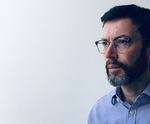
Andrew Anderson : Associate Artist
|
|
Random Audio Sample: Piano Quartet No. 1 : for violin, viola, violoncello & piano by Andrew Anderson, from the CD Piano Quartets 1 & 2 |
Email:
Artist website: http://www.andersoncomposer.com
Andrew Anderson was born in 1971 in Melbourne, Australia, where he studied composition with Rodney Ford, violin with Barbara O'Reilly, and piano with Aarvon McFadden.
He has been the recipient of two Masterworks prizes (ERMmedia, USA) for composition, resulting in recordings of his works by the Czech Philharmonic and the Prague Radio Symphony Orchestra.
Anderson has written several choral works for the Christian liturgy, this writing being informed by engagements with parish choirs in both the USA and the UK, as well as private tuition in singing with Nigel Wickens (Cambridge, UK). He also has an interest in encouraging community engagement in music performance, being the founder of the University of Melbourne Artists Register.
Andrew Anderson — current to March 2020
Selected Commissions
| Work | Commission Details | |
|---|---|---|
| I sing in my heart (satb choir with string orchestra) (2023) | Commissioned by Brett Weymark for performance by Sydney Philharmonia Choirs. | |

|
Theme & Variations : for solo cello (2021) | Commissioned by The ANAM Set, Australian National Academy of Music (ANAM). |
|
|
I sing in my heart : SATB choir (2020) | Brett Weymark for the Sydney Philharmonia Choirs |
|
|
There is one body : SATB choir (2019) | Commissioned by the Rev. Matthew Williams for St James' Old Cathedral on the occasion of the baptism of Malachi Altin. |
|
|
Songs of Sleep : voice with piano (2019) | Commissioned by Alexandra Mathew |
|
|
He Gives His Beloved Sleep (satb choir with soloists and organ) (2018) | Commissioned by Matthew Williams for performance by St James' Old Cathedral, Melbourne. |