 |
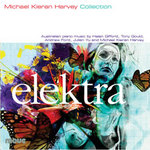
CDElektra / Michael Kieran Harvey collection.
|

Featured Australian works
| Work | Composer | Performers | Duration | MP3 | |
|---|---|---|---|---|---|
|
|
Folly (2007) for solo piano Recorded/performed at: Move Records Studio, 2007-2009 |
Andrew Ford | Michael Kieran Harvey | 12 mins, 48 sec. | Buy as MP3 |
|
|
Menin Gate (2005) — solo piano Recorded/performed at: Move Records Studio, 2007-2009 |
Helen Gifford | Michael Kieran Harvey | 8 mins, 42 sec. | Buy as MP3 |
|
|
Crossing (2007) piece for solo piano Recorded/performed at: Move Records Studio, 2007-2009 |
Tony Gould | Michael Kieran Harvey | 19 mins, 30 sec. | Buy as MP3 |
|
|
Elektra (1992) for solo piano Recorded/performed at: Elm Street Hall, North Melbourne, on 1992. |
Michael Kieran Harvey | Michael Kieran Harvey | 8 mins, 56 sec. | Buy as MP3 |
|
|
Sonata (2001) — solo piano Recorded/performed at: Move Records Studio, 2007-2009 |
Julian Yu | Michael Kieran Harvey | 24 mins, 18 sec. | Buy as MP3 |
Product details
Michael Kieran Harvey is one of the foremost interpreters of contemporary piano music of his generation. A champion of Australian music and himself a composer, he regularly commissions new Australian music and has performed Australian music with Australia's leading contemporary music ensembles and orchestras.
Kieran Harvey writes:
...'I had spent some time exploring the intersection between what
a composer hears, then realises on the computer, and then what is
humanly possible in live performance. Ives, Nancarrow,
Ferneyhough, Stockhausen, Boulez and others had been pushing
these boundaries well before the rise of the PC but the ease and
complexity of computer-generated music for the piano now begs the
question: what is the performer for?
'If the performer will only be able to execute the score with
varying degrees of failure, what is the point in attempting it in
the first place? Should the composer ignore his/her own creative
desires and only write what is comfortable for the performer and
audience? It boils down to whether humans wish to listen to
intelligent machines or other humans. The answer seems to be: it
depends. The prosthetic integration of artificial intelligence
with human intelligence is an increasing fact of life within art.
One wonders though whether an intelligent machine would ever want
to play or listen to music for its own satisfaction.
'I came to realise that what I was looking for in live
performance could be found in Australian improvising pianists
like Grabowsky, Nock and Tony Gould. There is in Gould's music -
an experimentation and absorption in the moment; naturally a
refreshing spontaneity but also a humility that is totally unlike
the more painful histrionics of his overseas colleagues. The
sense of playful irony is clearly evident in the music of Ford
and Yu, where ancient forms are reinvigorated with the energy of
popular music. The dark aspect of human technological advancement
through human slaughter is mourned in the Gifford work Menin
Gate.'
'Each of the works on this CD I think strives to express the
tension in music between formula and spontaneity.'
Duration: 73 min.
Booklet includes programme notes and biographical information on composers.
Related products

Score: Menin Gate / Helen Gifford.
Score: Sonata : for piano / Julian Yu.
Score: Piece for solo piano : (The Crossing) / Tony Gould
User reviews
Be the first to share your thoughts, opinions and insights about this item.
To post a comment please login