20 May 2026
A Sutured World: Liza Lim and the impact of an idea
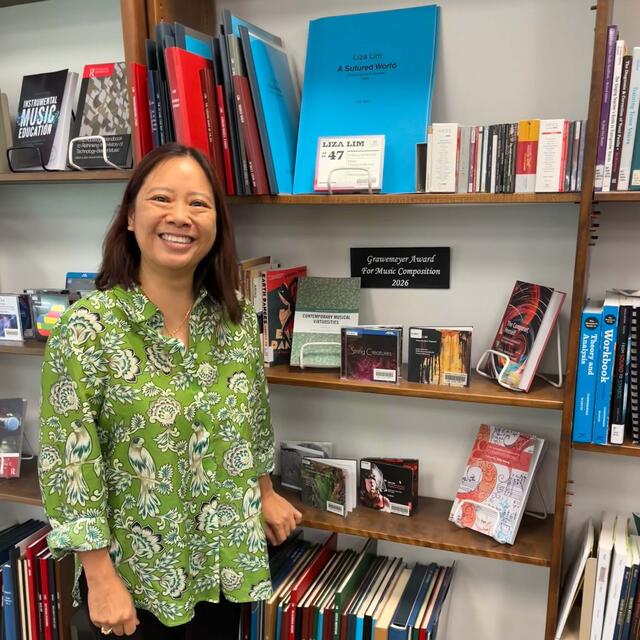 Image: Liza Lim in front of library display of complete collection of published scores (Ricordi Berlin), CDs and reference books
 © Matthew Ertz
There is something quietly disarming about the Grawemeyer Award for Music Composition. For an award that is financially generous, internationally recognised, and now firmly established as one of the most prestigious prizes in contemporary classical music, it resists spectacle. It comes with high profile events and ceremony, yes, but embedded in its ethos is a deep sense of authenticity, clarity and focus that remains at its core. Founded in 1984 by philanthropist and University of Louisville alumnus H. Charles Grawemeyer, the award was conceived to honour excellence, but more specifically to recognise the impact a single creative idea can have on the world.
Into this lineage of creative thinkers, now steps Liza Lim, presented with the 2026 Grawemeyer Award for Music Composition for her cello concerto A Sutured World, written for Nicolas Altstaedt and premiered by the Bavarian Radio Symphony Orchestra in 2024. Lim is only the second Australian composer to receive the award, following Brett Dean, and joins a list of recipients that includes figures such as Witold Lutosławski, Kaija Saariaho, and Harrison Birtwistle. Names that, for many composers, exist somewhere between influence and horizon.

Images: Grawemeyer
Award honour
board; Liza Lim portrait
As Director of the Grawemeyer Award for Music Composition and Louisville Music Librarian Matthew Ertz has noted, one of the award's greatest impacts lies in the inspiration it offers younger generations of composers and performers. Many recent recipients grew up alongside the award itself, encountering its history not as distant canon, but as living possibility. Lim herself has spoken about earlier Grawemeyer recipients Chinary Ung and Joan Tower and the deep impression their prize-winning works had on her as a young composition student.
Lim's work A Sutured World now sits as a firm part of the Grawemeyer Collection of Contemporary Music. A collection of scores, recordings, and submissions that began in a lock box owned by the library's first librarian, Marion Korda, and has now grown to nearly 6,000 volumes housed at the Dwight Anderson Memorial Music Library, Louisville. Music that is regularly performed sits alongside music that hasn't yet found its way to wider audiences.
"To me, some of the most valuable items [in the collection] are
the most recent batches of nominations, since these are generally
brand-new pieces that have not yet been published or recorded." -
Matthew Ertz
There is something significant about a collection that holds music the world hasn't yet encountered. A kind of institutional patience, keeping faith with work that may still find its moment and reach future listeners. That faith is not always a long wait. In its first season, A Sutured World, was performed by co-commissioners Bavarian Radio Symphony Orchestra, the Royal Concertgebouw Orchestra (collaborating with the Cello Biennale Amsterdam), Melbourne Symphony Orchestra and orchestra of Casa da Music Porto in addition to the premiere with the Bavarian Radio Symphony Orchestra. It was also released on BR-Klassik garnering multiple rave reviews including in Gramophone, BBC Music Magazine and Limelight Magazine. Upcoming performance seasons see the work being performed at Musica Nova Helsinki, Klangspuren Schwaz and at the Elbphilharmonie in Hamburg. It exists at once as archival object and living idea, finding its meaning through performance and in the ears of listeners.
The Grawemeyer Award for Music Composition has always distinguished itself through its unusual relationship to listening. After two rounds of expert judging, the final decision is made by a lay panel evaluating the shortlisted works anonymously. While many panel members have extensive musical knowledge, they are not professional composers or performers. They are engaged listeners: concertgoers with a genuine investment in contemporary music. A unique gesture for such a prestigious award and a reminder that whatever else new music may be, it is also an act of communication between creator and listener. Lim's award-winning work is very much that kind of conversation, one that asks both performer and audience to remain present within its difficulty.

Images: Liza Lim signing the
guest book; with music students in the Library
A Sutured World offers an idea that is both philosophical and tactile. The title references suturing, the act of stitching up a wound or an incision. That in turn evokes things in the world (humans, creatures, landscapes) that are torn, lacerated, and wounded, and processes of sewing and binding edges together for healing. But rather than ugliness, Lim prefers to think of the Japanese art of kintsugi, where damage is repaired and illuminated (with gold lacquer) instead of being hidden. The cracks, the seams, the thread become part of the story.
Listening to the work, there is little sense of seamlessness in the conventional sense. Instead, the concerto unfolds through shifts, fractures, interruptions and returns. Revisiting material throughout the four sections from altered perspectives, as though testing the strength of the thread itself.
Lim has spoken about her interest in what lies behind "stumbling blocks", those moments where progress falters or certainty dissolves.
"It may not be much fun but it's interesting to be 'lost'. I held on to an idea that the stumbling blocks covered something very valuable which could not be reached via known pathways…" - Liza Lim
It is a familiar experience within compositional practice, though perhaps not one always encouraged within cultures that privilege fluency, productivity and forward motion. In A Sutured World, difficulty is not an obstacle to meaning, but a condition of reaching it. The work repeatedly asks how does light arrive in the world? How can darkness and illumination coexist in paradoxical relation? Lim's answers are fragmentary: through cracks, breaks, lacerations. It is a poetic proposition, certainly, but also a practical listening strategy. Rather than hearing rupture as failure, we are invited to hear it as a site of possibility.
"A Sutured World calls for a world sewn together by acts of repair, reciprocity, imagination, and play. There may be scars but we can make them into something illuminated. Through creativity, through listening we can find paths towards shared resonance." - Liza Lim
The Grawemeyer Award, with its emphasis on ideas capable of travelling beyond specialist discourse, raises an important question: What kind of listening does this work invite?
"One puts work out there, but the meaning only truly comes alive with the listener. They are the necessary partner that completes and renews the art. And I think that co-creative relationship shows how we all matter. Our presence counts. Our listening counts in the world." - Liza Lim
© Australian Music Centre (2026) — Permission must be obtained from the AMC if you wish to reproduce this article either online or in print.
Subjects discussed by this article:
Liza Lim is an Australian composer, educator, and researcher whose music thinks with ritual, material agency, and environmental philosophy across the cultural lands of a more‑than‑human world. Her practice articulates relations rather than objects, braiding beauty and rage with female spiritual lineages into emergent ecologies of sound.
Her large-scale cycle Extinction Events and Dawn Chorus has resonated globally for its urgent call to ecological listening. Lim’s music—spanning chamber and orchestral works and five operas—is published by Ricordi Berlin and widely commissioned by leading orchestras and ensembles. She holds the Sculthorpe Chair of Australian Music at the Sydney Conservatorium. In 2026, Lim received the prestigious Grawemeyer Award for Music Composition for her cello concerto A Sutured World, affirming her place as one of the most compelling voices in contemporary music.



Comments
Be the first to share add your thoughts and opinions in response to this article.
You must login to post a comment.