1 October 2026
Beyond a Bio: Andrée Greenwell
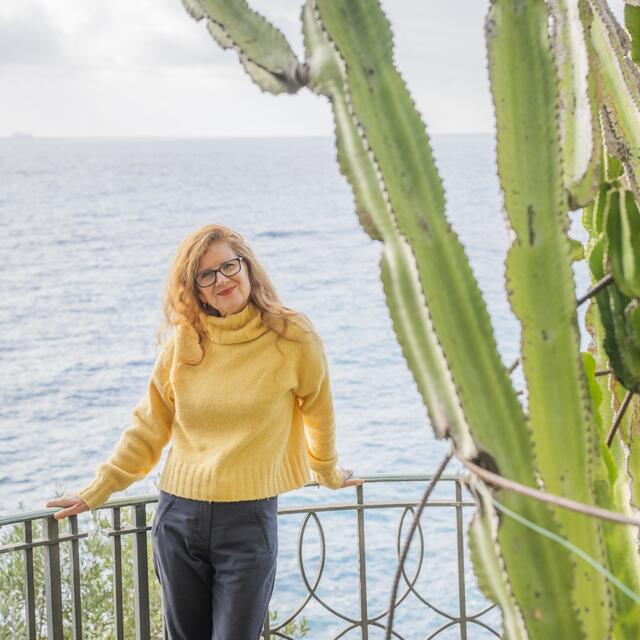 Image: Andrée Greenwell
 © Photo by Laura Bainchi
As artistic director of Green Room Music, composer Andrée Greenwell is a leading creator of innovative music theatre and chamber opera, involving musicians from contemporary classical, popular music, indie- and improvisation scenes. Four of her major works have been presented by the Sydney Opera House: the chamber opera Three Marys, the retro-indie post-punk musical The Hanging of Jean Lee; Dreaming Transportation; and LAQUIEM: Tales from the Mourning of the Lac Women.
Awards she has won include the Australia Council for the Arts Music Fellowship and NSW Women in the Arts Fellowship. She was also a resident artist at Chateau de La Napoule (2002); participated in the Women Opera Makers Workshop, Festival of Aix-en-Provence (2024); and was a Fellow at the Bogliaso Center, Italy (2026).
In this edition of Beyond a Bio, we find out more about her creative process, inspiration and current projects.
How would you describe your music to someone hearing it for the first time?
Narratives of expression in music textures; song and then beyond song. I am a good melody writer. Lots of people describe my music as "eclectic" which can carry disparaging connotations e.g. dilettante, an outlier to the Western hero/heroine genius-composer-virtuoso lexicon. People often say about my music and the contexts I make for that it's "difficult to box in, define etc." It is true that I draw from various music traditions, then arrive at something new. I think there is always emotional impact in my music.
How does a new work usually begin for you?
For me, a new work often begins with an extra-music concept or a text. I often live with the idea or text for a while to test whether it is worthy of investing the time in - that will have lasting power. I still dread starting each time. There is a sense that I have never made anything before. I often sing and play the piano, or experiment with sonic material using a DAW, to test music concepts as a starting point. I keep experimenting, improvising and playing until I find an idea that is strong, that seems to have an internal energy with capacity to grow. I find that if a starting idea is solid, interesting, has integrity, the music unfolds itself in a way. There is an energy with the idea that takes over, it is almost as if the music is writing itself. This is something the late writer and philosopher Ross Gibson talked about with me when we were discussing the creative process.
What ideas or sounds are inspiring you right now?
I have been listening to environmental sound recordings from Iceland as part of my research for a new choral project. This is very cool and inspiring.
Can you tell us about a recent project or work?
My last major work was Three Marys a chamber opera that premiered at Sydney Opera House and was presented by SOH for its 50th anniversary celebrations with a libretto by Christine Evans (Aus/US). Sung in English with French and Arabic, Three Marys is inspired by the French medieval myth about the biblical women's perilous journey from the Middle East to the South of France. It was wonderful to have young singers from the NSW Arts Unit involved. The full opera is up on the Sydney Opera House website. It was immensely exciting to have the SOH Broadcast Unit film the piece, so I am giving that a plug because it is rare to have one's opera online let alone in that venue!
What do you hope listeners experience in your music?
Connection. The sensual,
sensory and transformative power
of music. Pleasure. Disturbance. That there is a space to
reflect, be in the moment, take something from the experience
home. The acclaimed German choreographer/dance-theatre legend
Pina Bausch said "To understand what I am saying, you have to
believe that dance is something other than technique. We forget
where the movements come from. They are born from life." If you
can excuse the hubris, my feelings about my own
music-making echo this.
I think my
music allows the listener to
enter and discover narratives of
emotion and expression - the sensory - first, which is
supported by and accessed through
technique, the tools.
Image: Andreé Greenwell, photo by Matthew Duchesne
Where do you work best?
I love to work in my home studio. I am surrounded by my music and instruments, and the walls that have heard the previous pieces in progress since I moved here with my family about 14 years ago. I also hear the birds sing in the yard outside. I find composing to be a disciplined meditation and need to be in a space where I am talking to and listening to the work, with attention to detail. If I need to work away from home it has to be a quiet room. I find working in a theatre rehearsal room with a laptop and headphones difficult, for me there are too many distractions to be efficient - I will want to chat! Let me run away to my own little sacred space with my laptop. Saying this, I have gotten up very early or worked late at night on theatre tours to revise and output score files for playback on demand. I used to work late into the night/early morning hours when I was younger. Now, I prefer the mornings and optimally get into composition well before 9am. Your ears are the best early in the day and fatigue as the day progresses. If I start the day answering emails or attend to any administration, my brain goes into admin mode and it becomes difficult to wrench it back into composing mode, which I feel keenly as a very different way of thinking.
What's something people might not expect about your creative process?
I find the composing process addictive, and when I am in that zone I can't let it go because what I am writing plays over and over in my head until its first performance. I keep refining drafts until I am happy with structural balance and that the lines are memorable and purposeful, and that there is a sense of the "aliveness" of the music - that it wants and deserves to be played. This is importantly assisted by intuition, one's ability to self-critique which is a crucial skill to develop. The administration required to get ambitious independent works up takes as much time as the composing. This has not become easier over the years.
In terms of what is unexpected, when I worked on the music theatre work Behind the Cane, co-composed with David Bridie for Queensland Music Festival in 2011 I took up ukulele because so many artists from the Australian South Sea Islander (ASSI) community of Bowen played uke and were amazing singers. Right now I have a strong choral focus so I joined the choir Coro Innominata - it's the best and most enjoyable way to learn. This also takes me outside my own music which tends to be on replay in my head. Composition means a lot of alone time. I am appreciating having a community music experience outside of my own composition practice. It is indeed lovely that Coro Innominata performed my "Angels in the Night" to a lyric by Felicity Plunkett at the Inner West Choral Fest and again at St Thomas' Church in August.
If you had to name one Australian work everyone should hear, what would it be?
Well, I am not a fan of the everyone should, and "best of" composer lists so I will mention a couple.
I was really struck by Carl Vine's Love Song (1986) for trombone and tape, performed by the incredible West Australian trombonist and teacher, Simone de Haan. I saw Simone perform this piece at the VCA in the orchestral studio when he was on staff there. My memory is how lush and glorious the textures were. It was an unashamed minimalist release, and I recall composer Warren Burt's comment about that. I still have a beautiful book on Mark Rothko, Morton Feldmann and Philippe Guston that Simone leant me, and I just couldn't quite bring myself to return.
Recently, I saw Tracey Moffat's film Bedevil (1993) again on SBS which was scored by Vine. The score which Vine also conducted remains so imaginative, dynamic and accomplished. Moffat's film is outrageously brave in its storytelling mode which crosses boundaries between visual art and film making. It's the first Australian feature film directed by a First Nations woman. There are fantastic dance sequences choreographed by Stephen Page both in-scene and as optical effects that transition between the three short ghostly stories. Moffat's work was one of a number of innovative films of the time that inspired me to go to film school and study sound production (AFTRS), where I went on to direct and compose a couple of short films that were highly successful internationally. I am sad to say that I cannot imagine this kind of adventurous film being funded in Australia today. Vine's score is terrific - ensemble with electronic elements that sound to me like the Fairlight CMI - I have not been able to confirm this. I would say this is a must-see Australian film, even if there are a few clunky moments.
Another work that impacted me was Recital co-created by composer David Chesworth, director Douglas Horton and the recently deceased soprano Helen Noonan. There is significant use of operatic repertoire in the "ghost of opera's" concert. Chesworth created a score of synthesiser layers, sampled orchestral recordings and piano accompaniments to the aria excerpts and wonderful monologues that feature virtuosic sprechstimme. Helen did not have the most beautiful singing voice but she was a force as a performer, and like the looping samples of the score, executed compelling "looped" physical shapes with her body, of superb rhythmic precision. Noonan's costume was like a set - created by the talented Jaqui Everett who sadly died very young. Both Jacqui and Helen contributed to my first Chamber Made Opera production of Sweet Death (1990), Helen also performing in my video-opera clip Medusahead that screened at many international film festivals, also bought for television screening in France, Holland and Australia. Recital toured the world - Chesworth recalls somewhere between two and three hundred performances. In terms of the feminist deconstructions in opera and music theatre, this one has playfulness and rigour in its dramaturgy. I recommend it to contemporary opera and new music theatre makers.
More recently I was taken with First Nations artist Dr Lou Bennett and Paul Stanhope's collaboration Nyilamum Song Cycles. I think this work is such a mature and balanced collaboration between the two cultural traditions, and the artists. You can hear that both composers have listened so closely to each other in the making of the work.
What excites you about Australian art music right now?
I think there is a lot happening in small-scale performances right now, because the main venues are prohibitively expensive. Like 21 Shepherd St Marrickville and Church Street in Camperdown near where I live in Sydney's Inner West (noting the sad closure of Lazy Thinking in Dulwich Hill). Passionate individuals - Michelle St Anne and Guy Gross - give so much to jazz, experimental and arts music makers through these venues. Saying this there is a downside to this hive of activity - venue costs and slashed NSW state and our capital city's funding round dates to once a year are seriously impacting the creation and presentation of performing arts and music activity in NSW, keeping a lot of deserving work out of general public engagement and appreciation, let alone critique. We are not the only state navigating this utterly crushing funding approach. If you are not available to make that one state/city annual funding day here you could be looking at up to a two-and-a-half-year timeline for your next grant application from that source. And that is for the privilege of applying, before you even think about the percentage likelihood of success.
I think the next generation have lots of energy and a range of opportunities that were much less frequent when I was a younger composer. There are many brilliant creative musicians coming through our music institutions who deserve support in establishing mature and sustainable careers, not just emergent ones. I am impressed by what I know of the music of experimental violone player Chloe Sobek, the entrepreneurial activities of Liz Jigalin including through the Music Box Project, the activities of saxophonist/composer Jeremy Rose, UK-based Australian vocalist Lotte Dean, and pianist/composer Ronan Apcar. I am thrilled that I can hear artists at the top of their game such as The Necks and the Australian Chamber Orchestra who are an utterly outstanding ensembles in my home city.
What's next for you?
I recently finalised a draft of a new piece for the wonderful vocal ensemble Luminescence for their program "Particles of Light" that premiered at The Vault in Canberra on September 11. It's touring regional NSW with performances in Wollongong, Braidwood, Newcastle and Bundanoon, including a performance at the Utzon Room at Sydney Opera House on October 29. I am adding that Luminescence is also a really exciting group coming through. Next, I start work on an international collaboration for a dance piece by choreographers Sandra Kramerova (Slovakia/Spain) and Anastasia Kostner (Italy/NL) that will tour Spain, Netherlands and Italy in 2027.
Anything else you'd like to add?
I am part of a great project initiated by Brisbane's Muses Trio who are commissioning a number of composers to make arrangements of songs by Australian popular music artists for Her Australian Song Book. The project will also provide mentorship to five young composers by Dr Natalie Nicolas. Anyone who would like to support my arrangement of Sarah Blasko's "The Way" can do so here.
© Australian Music Centre (2026) — Permission must be obtained from the AMC if you wish to reproduce this article either online or in print.
Subjects discussed by this article:
- Andrée Greenwell (Interviewee)



Comments
Be the first to share add your thoughts and opinions in response to this article.
You must login to post a comment.