12 November 2026
Écologies Résonantes: Learning to Listen Otherwise
© Image supplied courtesy of Earthly Futures, 2026
On ecological listening, Australian sound worlds and the beginnings of Earthly Futures.
What might we hear if we listen beyond the human?
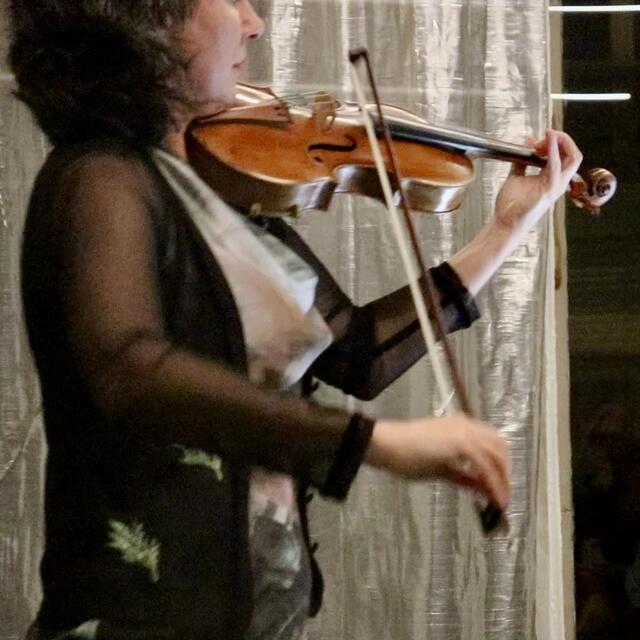
On the 10th October, Earthly Futures gathered in Paris for Écologies Résonantes at the site of Le Peloton Studio. It was an evening of contemporary Australian music, field recordings including a discussion about ecological listening. Bringing together Australian musicians Dr Anna McMichael, Dr Felicity Wilcox and Kate Moore, the programme moved between forests, oceans, Antarctic ice and the memory of landscapes, in particular, the sounds of the Australian landscape, hoping to ask what it might mean to listen to ecologically for and through non-human ears.
This evening also marked the first public programme of Earthly Futures. First sporing as an extension of my personal artistic practice, it has now, of August 2026, established as a Paris-based non-profit organisation working across art, biodesign and research with a central objective of ecological thought. Since its very first moments of growing mycelium objects in my kitchen, the organisation has has taken shape through a constellation of artistic experiments, biological research and sonic gatherings, bringing different forms of knowledge about ecology into proximity. Écologies Résonantes represents this approach, drawing together artistic research, ecological thought and the possibilities of listening as a shared practice.
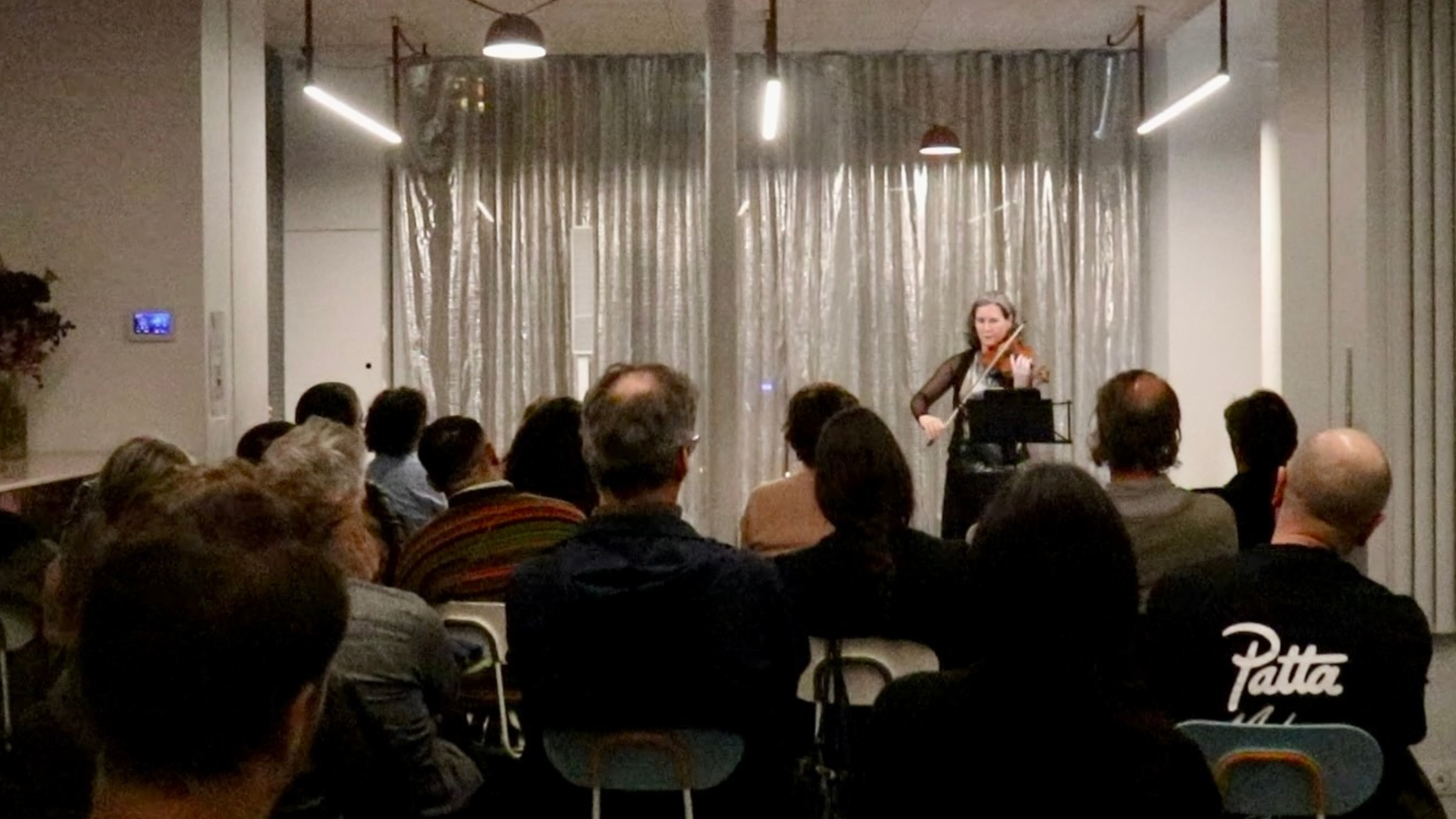
Image supplied courtesy of Earthly Futures, 2026.
Listening is never entirely passive. It asks something temporal of us, often a willingness to sit with what we may not immediately understand, particularly of the non-human world. It was the theme that shapes most of our sonic gatherings or listening inquiries and one the collective research and work of musicians and composers such as Anna, Felicity and Kate brought to the fore.
In Inspired by the Weddell Seal, Dr Anna McMichael brought violin improvisation into dialogue with underwater recordings of Weddell seals from the McMurdo Oceanographic Observatory in Antarctica. Their vocalisations, funnily bringing to mind European electroacoustic works from the 1970s and 80s, inhabit a world of ice, water and extraordinary acoustic complexity. Almost alien-like and heard through the performance, these underwater vocalisations invited audiences to encounter animal communication beyond the familiar boundaries of human language and musical convention. What happens when we attend to another species on its own terms and are musically in dialogue with it, while acknowledging the limits of our own understanding?
From another perspective, Dr Felicity Wilcox approaches ecological listening through the intimate soundscape of place. In Currawong Call, recordings of currawongs near her home in Darug Country (the Blue Mountains) become part of a graphic-score-based composition. It was moving, particularly to the many Australians in the audience, to be hearing these ornithological calls from home in central Paris. Informed by Pauline Oliveros' practice of deep listening, both her works performed that night Currawong Call and To the Sea allowed us to reflect on how sound that might otherwise recede into the background of human activity, finally come into focus, reminding us that the world has been making noise all along, whether or not we remembered to listen.
The final work of the evening, Kate Moore's Bloodwood Variations, brought a different dimension to the programme, carrying with its acoustic world-building, the weight of ecological loss experienced recently by Australian landscapes. Together, this quartet of works offered distinct approaches to ecological listening: the complexity of beauty and grief we are confronted with climate change.
These questions sit at the heart of acoustic ecology, a scientific field concerned with the relationships between living beings and their sonic environments. Through field recording, sound can alter our relationship to a place, drawing attention towards something we might otherwise overlook. It can also reveal the limits of our listening, reminding us that the world is full of communications we humans cannot fully interpret, and lives that continue beyond our perception of them.
For Earthly Futures, this offers a way of approaching ecological questions through our ears. Art can create moments of curiosity, intimacy, uncertainty and recognition for these unknowns.
These experiences do not aim at resolving the complexities of living through ecological change, but we hope that they may shift the terms, and maybe the senses, through which the living world is encountered.
Earthly Futures grew from a desire to bring different forms of ecological knowledge into proximity. Its work spans sound, material research, food, publishing and experimental gatherings, creating opportunities for artists, scientists, researchers, designers and communities to exchange ideas and develop new ways of working.
Acoustic Ecologies is one part of this wider undertaking and one of its four main pillars of research, braided together in a wild, mycelial network. Alongside it, the Living Material Lab explores living materials and alternative approaches to making particularly working with fungi; FermentCLUB approaches food through fermentation, culture and collective practice; and Soil Songs brings together publishing and ecological collective action. Each programme has its own methods, but all emerge from a shared interest in the relationships between human activity, more-than-human life and the living systems of our Earth. Rather than treating research as something that happens only behind closed doors, Earthly Futures seeks to bring it into public life through shared experiences and sociocultural life.
Écologies Résonantes also reflects the organisation's interest in cultural connections between Australia and Europe. The evening brought together the works of three Australian women working across contemporary music and artistic research in a Parisian setting, allowing their practices to enter into conversation through sound and ecology. Their work carries questions across borders, connecting the particularities of Australian landscapes with wider concerns about environmental change and our relationships with other species.
And so, there is something fitting about beginning with listening. Before an organisation can know what it might become, it must learn to hear: to the people around it, to the places it and its participants inhabits, to the ideas and practices that might find common ground.
Earthly Futures is still taking shape. Its
programmes will continue to evolve through collaborations with
artists, scientists, researchers, designers and communities,
across Paris and further afield. The ambition is to cultivate an
ecosystem of practice in which different ways of knowing the
living world can meet, challenge one another and develop into
something shared. Perhaps ecological listening begins here: with
the recognition that the world is already full of voices, and
that our task is to become more attentive to the conditions under
which we hear them.
Find out more about Earthly Futures at earthlyfutures.com
For more from Écologies Résonantes, you can
view this resource compiled by Dr Felicity Wilcox, accessed
here.
© Australian Music Centre (2026) — Permission must be obtained from the AMC if you wish to reproduce this article either online or in print.
Subjects discussed by this article:
Dr Victoria Pham is an award-winning Australian interdisciplinary artist, sound designer, producer, editor and writer. She is based in Paris, France. Her work explores deep listening, decolonial practice, bio-design, and gardening and cooking as acts of nourishment and resistance. Victoria is the founder of EARTHLY FUTURES, a Paris-based non-profit that focuses on ecological action.



Comments
Be the first to share add your thoughts and opinions in response to this article.
You must login to post a comment.