2 December 2025
In Conversation with Ros Bandt and Alana Blackburn about new works Re-Growth? And Debris
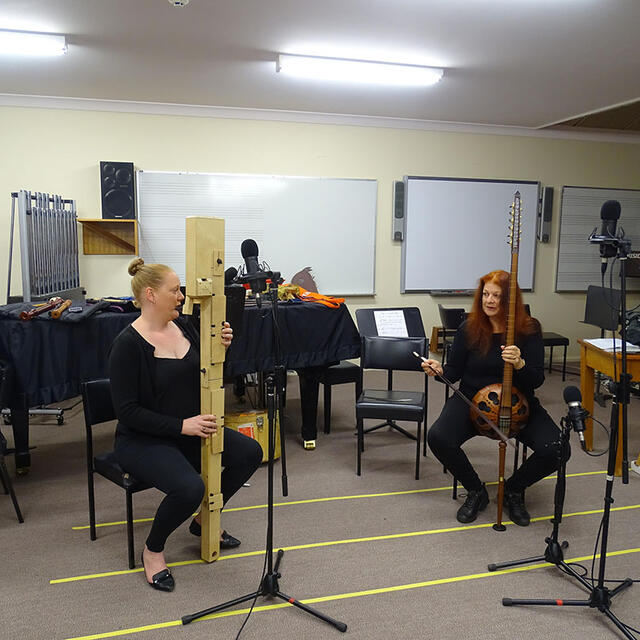 Image: Ros and Alana playing in the Music Room UNE
 Re-Growth? is a new site-specific multimedia work for recorders commissioned and performed by Alana Blackburn and composed by Ros Bandt. Debris is a collaborative work by both artists. Acknowledgements to Jim Atkins who did the audio engineering and Jutta Pryor who produced the visuals.
Melinda Barrie (moderator) recently invited sound artists Ros Bandt and Alana Blackburn to reflect on the creative processes underpinning the performance and composition of Re-Growth? and their subsequent joint composition Debris. The interview was held on the 9 December 2024 and conducted online on the lands of the Wurrandjeri peoples of the Kulin nations and the lands of the Anaiwan and Kamilaroi peoples.
Conversation
Melinda Barrie (MB): Thank you everyone for joining me today to discuss Re-Growth? and Debris.
MB First of all, when did you both meet and why Re-Growth?
Alana Blackburn (AB) I remember the first time I met Ros; it was at the Australian Computer Music Conference in 2012 in Brisbane. I was doing a live electronics piece by Benjamin Carey, Ros might not remember this, but as a as a fangirl I do.
Ros Bandt (RB) No, I remember you because I thought, who is this doing live electronics with recorders. The second time I met Alana was at the Tilde New Music Festival, Melbourne 2018.
AB Not long after Tilde, I contacted Ros about a commission to do a work about the environmental impact of the drought on the Armidale region. I was initially wanting to focus on the drought, but Ros and I got talking about all the different natural disasters that were happening at the time. So, we decided to expand the idea.
It was during these early conversations about the various disasters which were unfolding around us that we conceived of the elements that would later form the four movements of Re-Growth? Ros expressed her interest in taking on the commission and the potential of this work to tell the broader story of environmental devastation. So, I lodged a submission with Create NSW for a project grant to commission Ros to compose the work, which was successful.
RB I was really honoured that Alana asked me to do the commission. Thank you for inviting me.
AB Thank you for saying yes!
MB What was happening in Armidale at the time?
AB By 2019 Armidale had really suffered through a prolonged drought and had been given a day zero, which was the predicted date when the town would run out of water.
RB From my point of view, it looked like Armidale was having a whole world of peril with one disaster after another. I could not believe it. It was such an onslaught.
MB Was there any input from the New England community and traditional owners for Re-Growth?
AB Originally, we were going to have conversations with people in the community about their experiences of the drought. But due to Covid and reduced availability of traditional landowners we were limited in what we could do.
RB Prior to visiting Armidale I had a conversation with the Traditional Landowner (TLO) on behalf of the Anaiwan peoples of the Armidale region about our proposal. Nothing formal came of it. In the end we had a phone conversation where she kind of gave me a blessing, which made it feel ok for me to come and work on someone else's land. The closest I have come to an overall blessing during my career came from Auntie Alice for my 1992 Lake Mungo piece (Australian Music Centre n.d.).
In the end it was the very venue in Armidale where we worked on the pieces that was wrecked by the wind. The destruction helped shape some of the movements in Re-Growth? and led to our joint composition Debris.
MB Can you comment on working on Re-Growth?
AB The bushfires had been raging around Armidale, but it was not until later when Sydney started getting covered in smoke that it started making big headlines. Country folk had been dealing with this situation for a long time, yet it was not until Sydney started coughing that it made mainstream news. I wanted to do something to get the word out to people about what was happening in my region and spark conversation by telling our story through art and hope people would listen.
RB Why Re-Growth? To call out the environmental consequences of fracking and to work with Alana to address the elements, "fire", "air", "water", "earth" (Bandt 2021) about the area she lives in. The score may not seem like much when looking at it one movement at a time, but when it came time to put everything together there were hours of field recordings that had to be edited and mixed.
AB Jim Atkins and I went out to the site of the Bees Nest fire that had been badly burnt on the Dorrigo Plateau. That is where we took field recordings of our footsteps on the charred earth. Jim and I were moved by the place and the sound.
RB Yes you both looked so euphoric when you came back that day, like you had been to the haunted earth. The tune Alana played on the plateau would become the elegiac part of the work.
AB It is very easy to get excited about a project with Ros's energy when it comes to her work. She puts 110% into everything she researches.
I was able to immerse myself in the work because they are all sounds that I am familiar with having grown up with them. I am walking through the forest, I am on fire, I become a lyre bird calling and playing with other lyre birds. The visuals are playing across the front of me, and I become a part of the piece. Each time I perform it I have a different emotional response to it.
MB Comment on how you selected the instruments used.
AB The paetzold was always going to feature in some way, and this stemmed from the recordings Ros sent me of the koalas. She asked me to simply duet with them and send her a recording. The instrumentation we selected happened organically, for instance we used the sopranino recorder for the lyre bird because the pitch makes it the best instrument to mimic their sounds.
MB Can you discuss how the collaboration on Debris came about?
AB We made the music room at the University of New England a DIY studio and spent time experimenting with the different instruments. We jammed together and improvised using the recorders and the Tarhu. A year later, that same music room was destroyed by a super cell storm (observed as a tornado).
Ros said, well you know this place does not exist anymore and we have these recordings of the place. So maybe we should use them to compose a response to the disaster. I thought this was perfect!
MB Will Re-Growth? and Debris remain relevant? And were there any challenges?
AB A key factor in the Regrowth? commission was it was always going to be a collaboration of distance. The fact that we lived so far apart (Melbourne, Victoria and Armidale NSW), and the country was experiencing successive lockdowns this could have challenged the project and made it more difficult. Despite being thousands of kilometres apart we were still able to meet online. Ros would send me field recordings, and I would do some improvisations and send them back and discuss them on Zoom.
Music has always been a form of storytelling, a form of expression and a way of reaching broad audiences in different ways. I think these works will remain relevant for a long time to come because they speak to people in a way that touches them. This is very different to the way the mainstream media can. I mean they can talk about storms that wreck buildings, but for a work like Debris, when it was performed to local audiences, they could hear it, and it had the power to create a physical and emotional reaction in them. For context, at my last performance of it in Armidale, I provided a trigger warning. It was a respectful thing to do because some people had lost their homes.
RB I think you have been a fantastic regional advocate.
AB Thank you, and a point I would like to raise before we conclude is that we have some wonderful artists in regional Australia. Yet we are seen as too far away, or too separate from our metropolitan colleagues.
Despite the vast geographic distances and Covid. This project exemplifies the fact that two artists against the odds can still produce successful creative works.
MB Thank you Ros and Alana.
Endnotes
Australian Music Centre, n.d., Mungo: Installation by Ros Bandt, https://www.australianmusiccentre.com.au/workversion/bandt-ros-mungo/17067 accessed on 17 September
Bandt, R, 2021, Re-Growth? Program Notes, Armidale, Melbourne.
Melinda Barrie (author)
Melinda Barrie is a Melbourne-based archivist, working for one of Australia's leading universities. Her research interest has to do with sound, environmental and industrial heritage and she has written and presented extensively on the topic In addition she has a practical involvement and interest in the significance of Australia's audiovisual heritage. Barrie is the former editor of the Australasian Sound Recording Association's (ASRA) journal Sound Archive.
Ros Bandt
Dr Ros Bandt is an internationally acclaimed sound artist pioneering new forms of sonic art, site specific ritual performance in ancient world heritage sites and creating audience interactive installations over the past 4 decades. She is an expert historical wind player and collaborates cross culturally and internationally. She is published by Wergo, New Albion, EMI, Neuma Records USA, Move Records. Her commissions include the Paris Autumn Festival, the Greek Animart, and the Studio of Akoustiche Kunst, WDR, Koln, Radio ORF Wein. In 2020 she was awarded the Richard Gill Award for distinguished services to Australian Music. Alana Blackburn
Alana Blackburn
Acclaimed Australian recorder player Alana Blackburn is renowned for her mastery in both early and contemporary music. Graduating with first class honours and a Master of Music (Performance) from the Sydney Conservatorium of Music in 2007, she continued her studies in Amsterdam. Alana's performances span 500 years of music, seamlessly blending medieval, renaissance, baroque, and modern pieces. As a soloist and ensemble member, she has graced prestigious venues globally. Beyond her musical prowess, Alana holds a master's in arts management and a PhD, focusing on chamber musicians' professional identity. Currently, she serves as a Senior Lecturer at the University of New England, balancing teaching, research, and creative practice.
© Australian Music Centre (2025) — Permission must be obtained from the AMC if you wish to reproduce this article either online or in print.



Comments
Be the first to share add your thoughts and opinions in response to this article.
You must login to post a comment.