21 June 2023
Judith Hamann’s Spectral Ministration: Hums, Shakes, Saws and Other Sounds
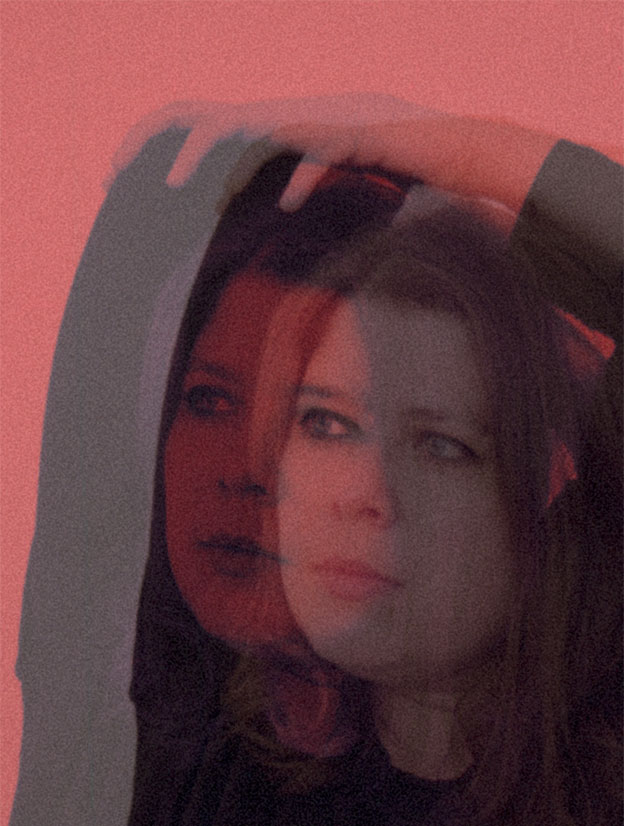
 Image: Judith Hamann
 © Milena Braune
It was November 2017 and Judith Hamann stood ready to deliver a solo performance. She extended the cello endpin to its maximum length. The large stringed instrument stood unstably far from the floor and Hamann braced it against her body while she waited. We were in San Ysidro, California, a few miles from the US-México border and you could see lights glittering in Tijuana from the THE FRONT Arte y Cultura's gallery window. It was the opening of the sound art exhibition Borders of the Echo curated by media artist, composer, and Hamann's close friend, Francisco Morales.1 He had taken a decidedly hemispheric and intermedial approach to sound art, which placed Hamann amongst photographic, sculptural, and filmic sound works from the US, San Diego-Tijuana borderlands, and points elsewhere in México.
Hamann leaned forward at the waist to bow the endpin. The bow hair hissed against the thin metal rod, accompanied by a high harmonic partial while the instrument's body responded with a low hum. The single, bowed action solicited three distinct sound strata with interaction and interference on their own. The performance traversed the instrument on the vertical plane: next, a low murmur from the tailpiece; after that, metallic partials sounded from the strings behind the bridge; later, Hamann bowed the strings as a cellist usually would. Each contact point activated a new resonant configuration - metal, wood, and steel-core strings - marked by distinct spectral content that bloomed under Hamann's care for the bow's vertical ascent. The performance gently diffused the instrument's integrity and introduced its resonant materials as so many divisible parts that could be put into mobile, non-hierarchical relationships. In these spectral adventures, one could imagine the cello in pieces, even as Hamann stood, with it, in front of us.
'I love the overlap,' Hamann shared in a recent conversation, 'between spectra and spectres.'2 This is a provocative suggestion. Hamann intimates that composite acoustic spectra like the ones she coaxed from cello's parts in this performance could also be understood as disembodied spirits, calling a listener to be hospitable and unsettled, all at once. Theorizations of the spectre preoccupied premillennial critical theory that grappled with history as the continued repetition of unsettled pasts that were wrongly assumed to have been overcome.3 Hamann is alive to these pressures and speaks eloquently about how the European-heritage instrument is, itself, haunted by discourses of control and mastery that iterate in other social and political fora.4 This draws Hamann to sounding practices that hover on borderline states and bring these tensions in the cello's material and historical constitution to the cusp of audible presence. Hamann summarises this relationship to sound as a ministrative practice.5 Ministrative work is associated with service, aid, and care for people's needs. Temporal urgency is also among its connotations. Ministrative service responds to crises, when comfort and solace are most needed. Hamann creates soundworlds that register a spectral, historical longing for ministrative repair. This work is at once material and speculative. While her hands-on work with unstable sounds dramatizes the player's and instrument's supressed vulnerabilities, it also asks what new patterns of coexistence become possible once these reciprocities are no longer hidden. This is one way, with Hamann, to encounter and care for the spectre in the spectral.
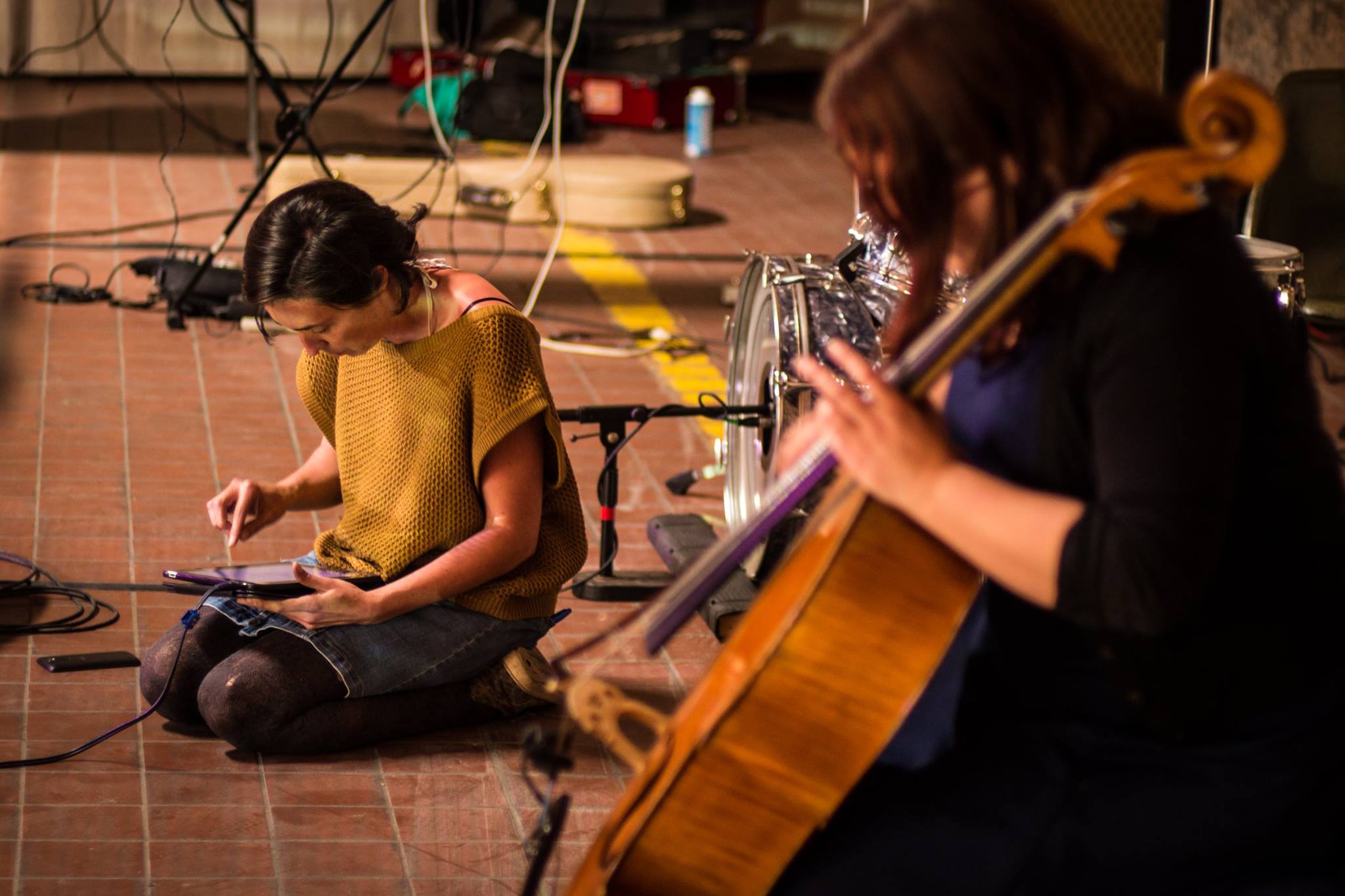
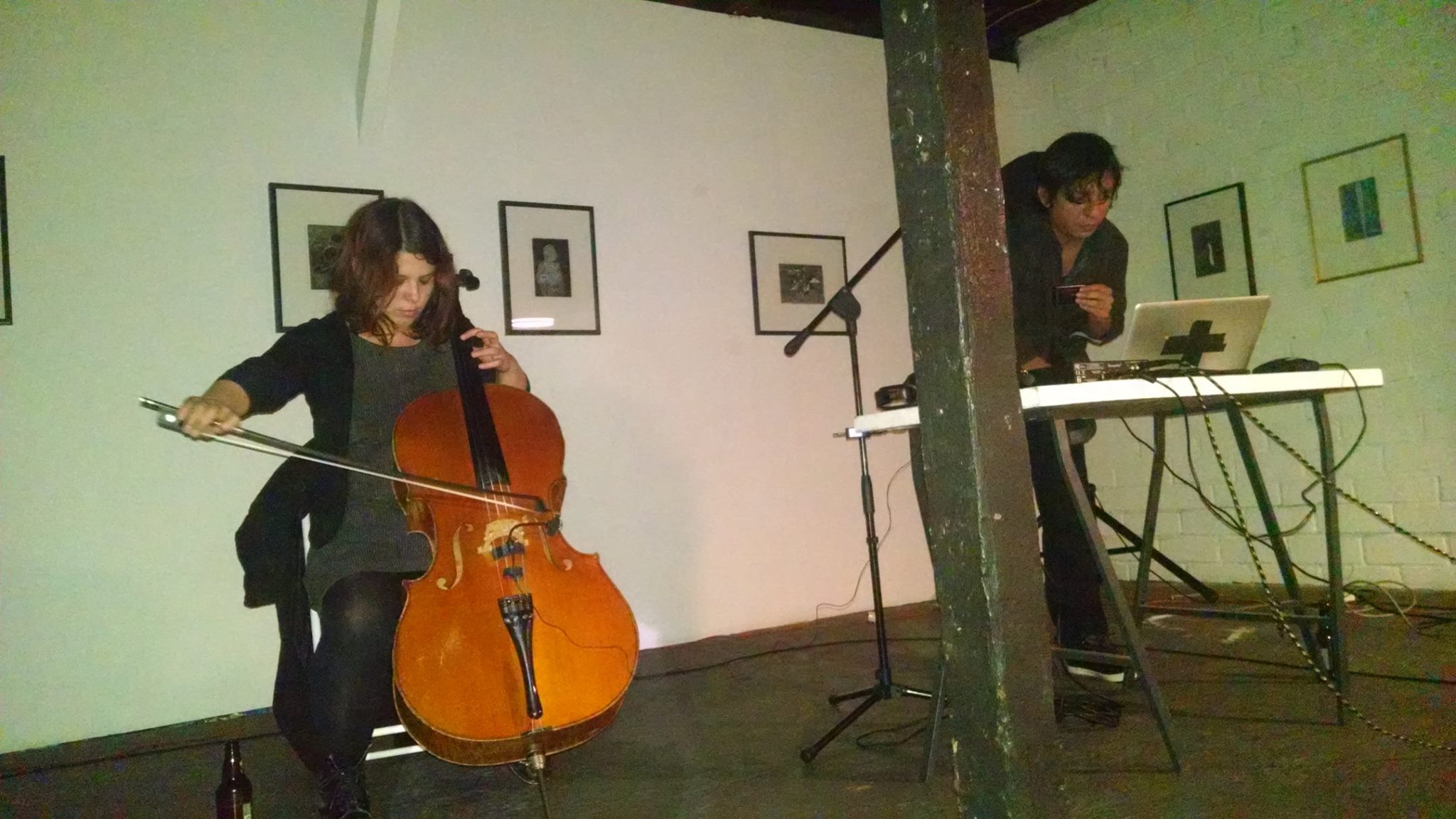

Hamann would depart San Diego a few months later, after having been a bright thread in its creative fabric since 2012, when she moved to the city to begin her doctorate of musical arts at UC San Diego. This was a generous and generative period. Based in Barrio Logan, epicentre of the Chicano movement in the 1970s and contemporary nexus of artistic and political organising, Hamann became a fixture in its regional DIY culture. Her collaborations were extensive. This included work with electronic musician Haydée Jimenez, who at the time, helmed the Tijuana DIY space nett nett; projects with Morales; collaborative work with label head, recordist, and, later, mixing and mastering engineer for Hamann's recorded output, Al Jones; installation, education and production projects with artist Armando de la Torre; as well as work with fellow UCSD graduate student Yvette Jackson on what would become Jackson's Radio Opera Workshop. In Logan, Hamann put together shows and festivals that wrenched UCSD music students and some faculty from its northern La Jolla fortress to collaborate with long-term stewards of crossborder experimental music and visual arts. While the Department of Music had been created and funded as a mid-century haven for modernistic composition and performance, by the time Hamann arrived, it had begun to embrace hybrid practices that combined composition, improvisation, fixed and interactive electronics, and performance art. Hamann's collaborative connections between San Diego and UCSD emphasised that it could contribute a real, vibrant stake in regional culture work. As Jones put it, this forged connections with others who made the city 'a more frequent stop on tours for underground, national, and international musicians and composers' in the late 2010s.6 Many of us in San Diego's experimental scene know each other now because Hamann connected us, years ago.
Readers familiar with genre-melting music scenes in Narrm/Melbourne, where Hamann also channelled much creative energy in the late 2000s, may sense a resonance with her energetic presence in San Diego. This musical formation could fill a chronicle all on its own. In December 2008, Hamann's trio Golden Fur with Sam Dunscombe and James Rushford started to put on its first major performances. The group gained momentum as the CalArts-modelled VCA music department was soon to be dissolved and reconstituted under the the more conservative University of Melbourne Conservatorium.7 This unleashed a last ditch experimental crest within the music department's funding and pedagogy, and for Hamann, became a kind of case study on institutional instability and the possibilities that emerge in its fissures. The trio's initial performances collided modernist masterworks like Morton Feldman's Patterns in a Chromatic Field (1981) and Helmut Lachenmann's Allegro Sostenuto (1987-8), 1970s Australian graphic scores, including the work of conceptual artist Robert Rooney and the first iteration of sound artist Marco Fusinato's Parallel Collisions (2008) alongside punk event scores with amplified beer cups and drinking games.8 'We didn't know what we were doing!' Hamann recalled, amplifying the trio's distance from canonic contemporary music power centres.9
During doctoral study, one might expect the artist to pursue research that asserts the singularity of their practice. Yet, Hamann, the ministative worker in sound, declined this path. Her dissertation text frames artistic trajectories through music for more than one cellist, spanning 2012 and 2018.10 It chronicles collaborations with Charles Curtis and other studio mates, and meditated on Hamann's untitled project with cellist and sound artist Anthea Caddy. Same-instrument multiples generate complex interactive spectral conditions and raise difficult conceptual questions about sameness and difference. Hamann makes two interventions. One: she questions what sounds 'belong' to a music work when spectral byproducts actually guide the performers' interaction and decision-making. And two: this locates the very constitution of a work in the relational paradoxes that performers navigate through these liminal sounds. These points become especially vivid in her reflections on Tashi Wada's duets - 'September 2006' and 'February 2008' - which Hamann prepared and recorded with Curtis in 2012-13.
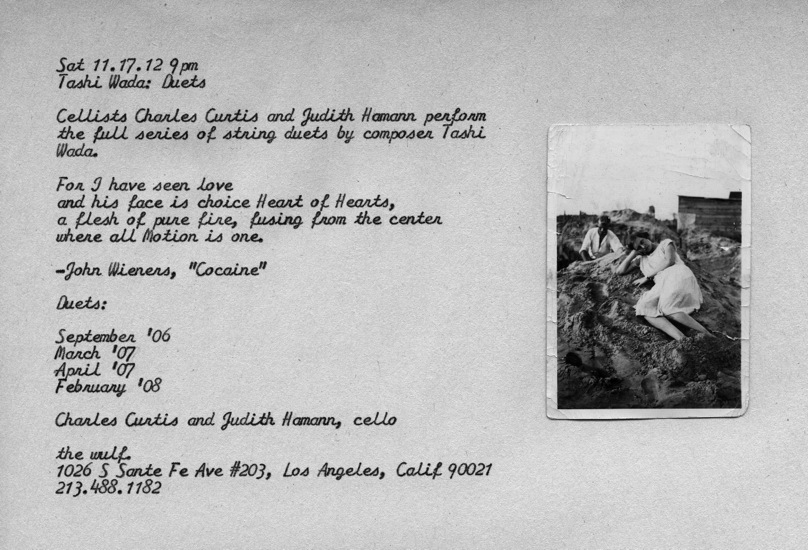
The first and last duets in Wada's four-part series, these pieces explore the relational paradox of unison playing, that is, two players are tasked to sustain an identical pitch or sound. In 'September 2006', two cellists slide the left hand along the fingerboard in complete synchrony in order to maintain the unison interval. The attempt to stay in synch, however, reveals the unison to be a relational state with perceivable differential effects: spectral interaction, disorientation between individual voice and instrument, and a heightened awareness of slowness with no temporal guide apart from the elusive unison motion itself.
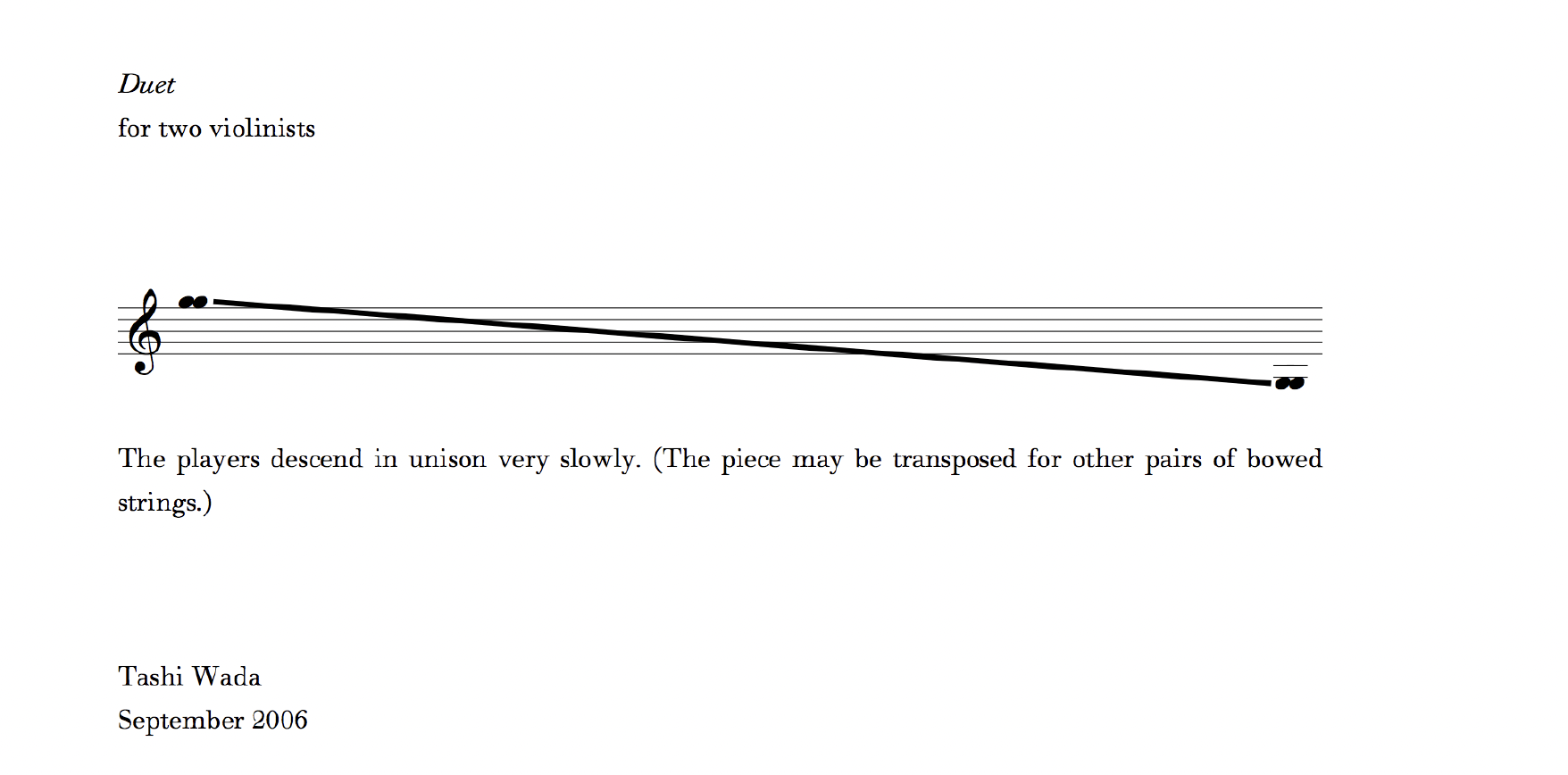
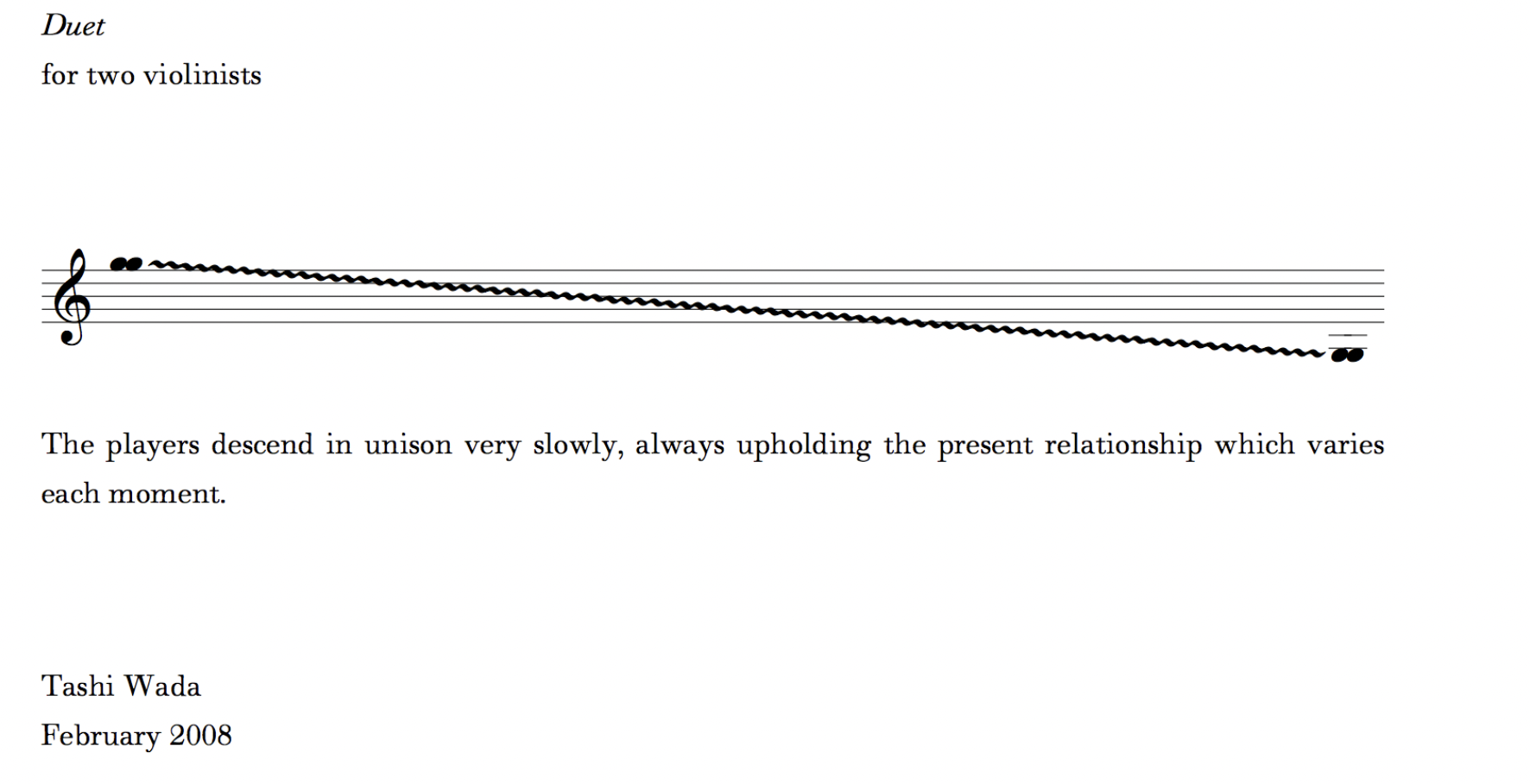
Wada's 'February 2008' inverts this paradox by making these differential states the subject of the players' unison efforts. But pursuing a present that 'varies each moment' makes it impossible for the players to determine if the unison should be difference or sameness. Instead, it becomes a cluster of relational responses and decisions nestled deep into spectral variance. Hamann, again emphasised that the impossible attempt at doubling becomes audible through a wealth of acoustic artefacts: intense acoustical beating when the players diverge slightly, 'flanging effects, the thickening of the doubled pitch.'11 Hamann experiments with terms like 'care,' in her doctoral text, in order to express the lessons about presence and absence, difference and convergence, erasure and exposure that arrive when multiple cellists navigate acoustical and spectral emergence. A heightened attention to sounds that are not just acoustically unstable but also often treated as unwanted effects emerges amid the ideal but impossible fusion with another's sound. Care, in this sense, invites these degraded sounds to anchor a new set of musical values where spectral interference and instability are the primary site for intersubjective connection. Care becomes a practical and conceptual lens that reframes musical material as relational activity across many scales: between players, basic intervals, parts of the instrument, the deep interior of spectral content and its unstable interactivity. This plays out in the basic but profound problem of how to touch the instrument and what kind of acoustical interface it is understood to be.
Between 2018 and the COVID-19 pandemic onset in 2020, Hamann continued these inquiries under much different circumstances. 'I decided I would not live anywhere,' they said in a 2021 interview.12 I imagine the blend of humour and seriousness in their voice. In those years, they threaded between artist residencies, stays with friends, and an astronomical number of solo performances. This called for a different working method. During that time, they explained, 'the thinking I was doing was worked through in performance,' that is, quite apart from normative division between practice and performance where 'practice' takes place in private space and 'performance' delivers the masterful, finished product. 'You're here now,' they summarised, again, leaning into spectral complexity as a place where real-time, hands-on musical thought happens. 'These partials, how do I take care of this as long as it wants to sound? How do I let other forms of relationality grow?'13 It's not hard to hear the relational emphasis in the work on multiple cellos folded into what became a solo practice. A solo performance is also, never just one.
This work culminated in Hamann's paired releases Shaking Studies (Blank Forms 2020) and Music for Cello and Humming (Blank Forms 2020). Each experiments with multiplication and shaking as creative methods. Hamann's work on shaking also links back to their time at UCSD, where I experienced an early iteration in installation form in 2014, which explored the therapeutic application of sub bass sound across a listener's body. At an appointed time, I laid down in a fabric enclosure built into a transformed classroom. From behind a curtain, Hamann mixed subs that surrounded my body as well as a headphone mix, creating a perceptual geography that separated ear-centred listening from vibrational conduction through the viscera.14 I recall emerging from the darkened room with great self-consciousness, having been worked over by sound in an institutional space where I was not expected to cede self-possession for even a moment, if at all. Even at this early stage, a vulnerability that cuts through mastery seemed active in the work which, for me, shimmered with a feminist attunement toward institutional discipline and power.

Hamann continued to explore shaking as a method to study relation and spectral complexity while pursuing other doctoral research. 'What if shaking then, which in itself is a kind of rhythm, could be considered a subject?,' they ask, 'An agent or investigator? What could shaking then reveal or tell us about matter, material, and self?'15 What inconsistencies and heterogeneities call to us when something is made to shake? That is, how far can internal differences stretch once shaking makes them expressive? Hamann imbues Shaking Studies with a narrative form that follows the shake from its emergence in the cello through its opening onto the world. The album opens with 'A Reading', in which the bowed cello endpin and tailpiece deliver pulse-like data flows, punctuated by metallic spectral flares. With this tremor rate drawn from the instrument's liminal materials, 'Pulse Study Parts 1 & 2' return Hamann to the bowed strings for two long studies that shimmer with spectral interaction borne on vibrato, bow speed variation, natural harmonic double-stops, wolf tones, and timbral nuances. The final piece, 'The Tender Interval' turns decidedly outward into the world with processed field recordings that index crunchy footfalls, ocean waves, and atmospheric ambience. For Hamann, the studies do not so much end as draw new materials in their gentle pulsational method. After all, the shake is also a wave, like other undulating phenomena: waves of political protest or a tide of COVID-19 infections. In waves, social formations also shake. No quietistic vibration, the wave that shakes is also a figure for contestation and confrontation, where people power exerts real pressure on entrenched structures.
The open-ended genre of study also carries the companion record, Music for Cello and Humming. Hamann nestles their five-part Humming Suite, comprised of three études and two fragments between pieces composed for them by Anthony Pateras and Sarah Hennies. In the études, Hamann snuggles the hum into near-unisons and weaves it through larger intervallic spaces, while the fragments brace the hum in an uncomfortably high vocal range with cello double stops behind the bridge. These polyphonic textures suggest that the cellist and instrument continue to shake, but have shaken loose new voices, relations, and effortful conditions to be cared for anew. The record concludes with Sarah Hennies' thirty-minute long 'Loss: For Cello and Electronics,' one outcome of Hamann and Hennies' frequent collaborations.16 A monumental conclusion to a record that plays between the gentleness of singing to oneself and the strain that keeps the hum enclosed, 'Loss' coordinates a long, tense glissando that again takes Hamann well outside their vocal range. Between long silences, we hear them quietly open the mouth: to breathe in, to gasp, and to cough. The closure that keeps the hum inside has now opened. To what? Surprise, curiosity, exhaustion or strain, we, the listeners, do not know.
This openness finds another kind of expression in field recorded and electronic projects, which have perhaps seen less attention than Hamann's cello-based work, although they share rich material and conceptual contours. Hamann's work with recorded sound abandons claims to environmental realism and contextless morphology that drive soundscape composition and musique concrète.17 This opens a fuzzier attention to context and spectral content that sits between what they call 'the anecdotal, domestic, the fragile,' with an intended nod toward composer Luc Ferrari. Consider Hinterhof (Longform Editions 2020), a continuous thirty minute environmental sound work based on soundworlds from the small, leafy yard that conjoins Hamann's Berlin apartment with other structures, a historical urban design that aspired to interclass interaction despite its hierarchical infrastructure. Environmental sound can dramatise paradoxes that structure everyday co-existence and the green hinterhof, for Hamann, was a complex contemporary and historical case in which they, as the recordist, could reflexively enter the frame. 'Why shouldn't we use sound as speculative fiction in a way that creates different realities that might put other ideas and experiences into motion?,' they ask.18 Spectres return in this historical fold. A field recording practice that accounts for these vast temporal layers is perhaps another kind of shake that can be cared for anew.
Hamann's ministrative work also includes collaborative sound support for a dreamy web of artist friends who work across in dance, comics, video, multi-media installation, and institutional critique, many of whom were co-residents during at the Akademie Schloss Solitude during 2021-2022.19 A substantial collaboration includes a performance and sound installation as part of Anike Joyce Sadiq's 2022 solo exhibition, the mixed media installation Mit Glück hat es nichts zu tun at Künstlerhaus Stuttgart. A ferocious work of institutional critique, the exhibition projected a multiple-choice questionnaire that Sadiq designed for the Küsterhaus members, employees and board. 'Are practising artists represented on the advisory board?,' one question poses, with other queries about race, gender, and ethnicity that press against the institution's investment in whiteness.20
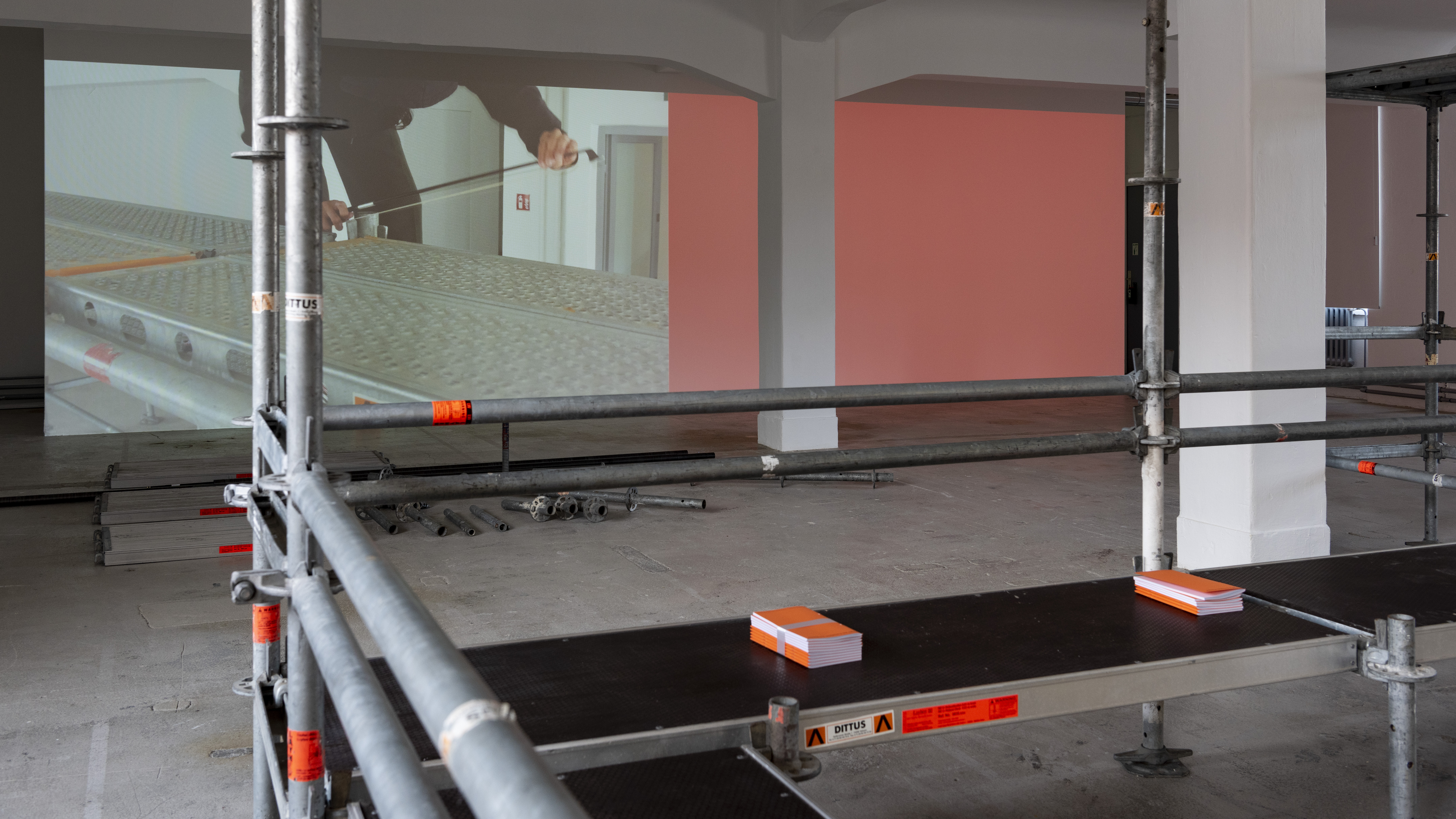
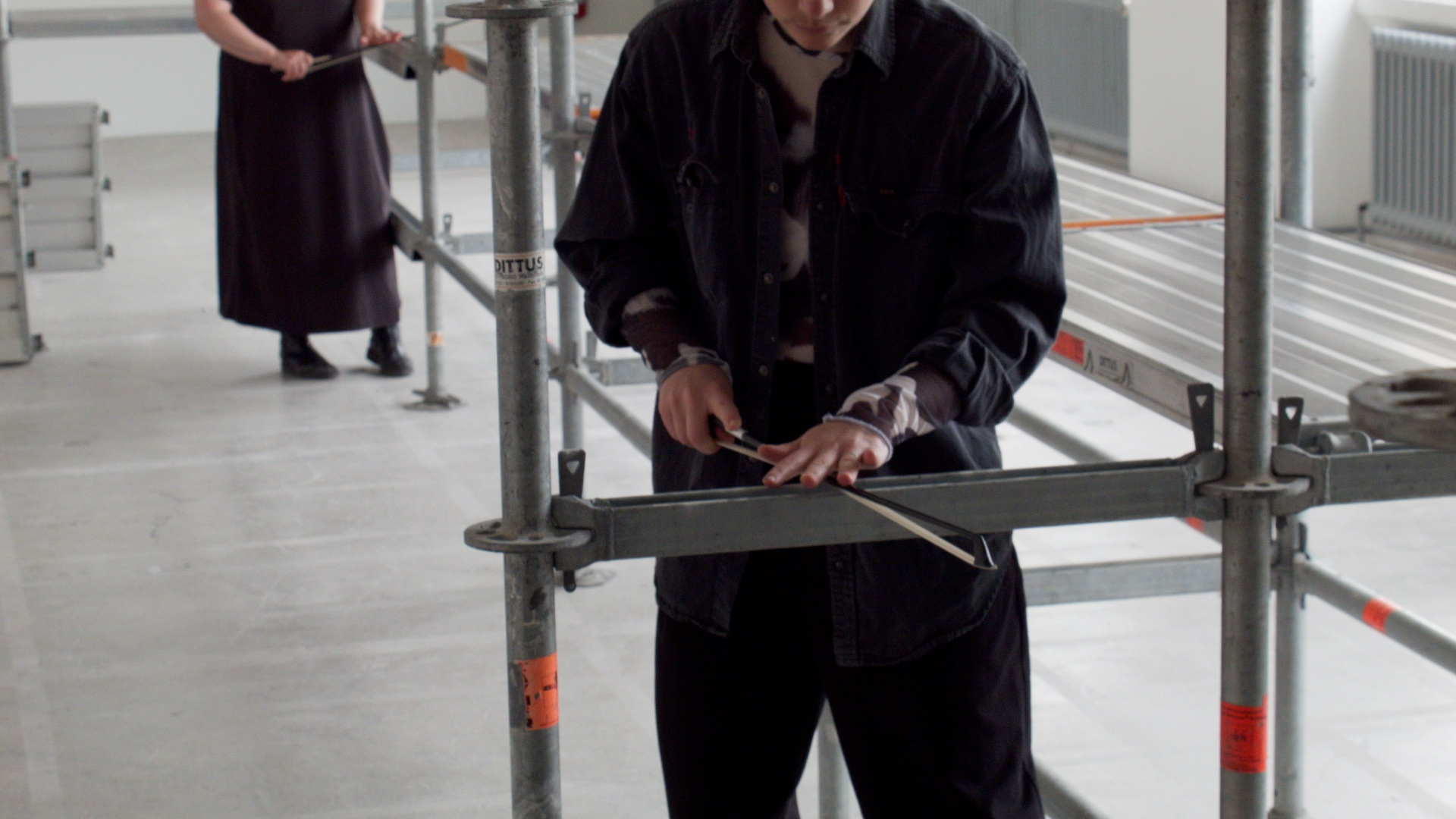
Inside the gallery Sadiq installed a rectangular scaffold shelter where activist groups met during the exhibition, a kind of ad hoc reading room with copies of Sadiq's fifty-five-page book, Against the Erasure of Dissent with essayist and artist Andrea Scrima. Part reading room, part autonomous zone, the scaffold proposes a gallery inside a gallery that shook the Künstlerhaus from the inside out. How fitting that that shake should be made audible, that the spectre that animates it should become sensible in some other way. Hamann affixed geophones and contact mics to the interlocked round metal poles. 'There's a beautiful video of Anike rubbing her body on the scaffold,' which connected the artist to the sonic life of the material. 'I was having a go at bowing it,' Hamann explained, 'and getting all this beautiful feedback; the structure sounds, it has a life and a resonance and is not static. It can speak, it can be tuned.'21 Sadiq saw the bow within a new relational nexus. 'She was like, "it's like a saw:" it's an activity of dissenting, 90 degree angles, the back and forth, the friction.' The material and semiotic gestures toward carving, dividing, breaking down, and constructing anew bring Sadiq's pressure on the institution across the threshold into spectral presence.
Hamann is an artist for whom care solicits materials, people, and relations to move in unstable and speculative ways. I use the verb solicit with great intention here. Consider the old Latin sollicitare, which means 'to shake all over, to make the whole tremble'.22 With Hamann, this is a way to do ministrative work in sound, its spectra and their spectres.
Footnotes
1 Francisco Morales. 'Borders of the Echo - Visualizing the Limits between Sound Art and Other Media,' Casa Famliar, 2018. https://thefront.casafamiliar.org/archivos/478
2 Judith Hamann, interview by Amy Cimini (Berlin / San Diego, June 2, 2023).
3 This literature is vast and much hinges on the reception of Jacques Derrida's Specters of Marx: The State of the Debt, The Work of Mourning and the New International (New York: Routledge, 1993) and Avery Gordon's Ghostly Matters: Haunting and the Sociological Imagination (Minneapolis: Minnesota University Press, 2008).
4 Judith Hamann, 'Artist Notes on Hinterhof,' Longform Editions, 2021 https://longformeditions.com/editions/hinterhof and Judith Hamann, 'Goose Apparitions,' Audiograft, http://www.audiograft.co.uk/judith-hamann-goose-apparitions/
5 Judith Hamann, 'Conversation with Judith Hamann,' interview by Keith Proski, harmonic series, (December 31, 2012), https://www.harmonicseries.org/p/112
6 A.F. Jones, email correspondence with the author, June 12, 2023.
7 Hamann, interview.
8 For a review of this event, please see Anthony Lyons, 'Golden Fur New Music Project,' Resonate Magazine, 2008, https://www.australianmusiccentre.com.au/article/golden-fur-new-music-project
9 Golden Fur's DIY 'fluidity of frame' made other electric relationships and collaborations possible. For example, they could be heard in the sumptuous orchestration of Francis Plangne's Tenth Volume of Maps (Mistetone 2012), in ceiling-shaking noise shows with True Radical Miracle and in extended configurations with Lizzy Welsh and Kim Tan. For Hamann, this period saw the beginnings of collaboration with the Argonaut String Quartet; work with Anthea Caddy, Carolyn Connors and saxophonist Rosalind Hall; as well as a formative commission for cello and electronic from Natasha Anderson.
10 Judith Haman, 'Double, Sync, Constellate, Realization Specific Works for Multiple Cellos,' (PhD thesis, UC San Diego, 2018). UC eScholarship, https://escholarship.org/uc/item/9ct0z3n8
11 Hamann, 'Double, Sync, Constellate, Realization Specific Works for Multiple Cellos,' 22.
12 Judith Hamann, 'Conversation with Judith Hamann,' interview by Keith Prosk, harmonic series, (December 31, 2021), https://www.harmonicseries.org/p/112
13 Hamann, interview.
14 I borrow this term from Maryanne Amacher, who used it to describe charged, sensuous interchanges between incident sound and differential responsivities along the auditory pathway, in the brain, across the skin and elsewhere in the inner body. For Amacher's discussion, see 'Psychoacoustic Phenomena in Musical Composition: Some Features of a Perceptual Geography,' in Arcana III: Musicians on Music, ed. John Zorn (New York: Hips Road, 2008). Although Amacher jettisoned this connection to the psychoacoustic shortly after presenting this research in the late 1970s, it remains a signal expression of her approach to creating a music that occurs within a listener's embodied circumstance of encounter.
15 Judith Hamann, 'SHAKING STUDIES,' Gender Diversity in Music Making Conference (Monash University, Caulfield VIC, Friday, 6 July, 2018), https://files.persona.co/60279/Monash-GDMM-conference-presentation-July-2018.pdf
16 For a wonderful conversation between Hamann and Hennies on 'Loss' and other projects, please see 'Loss: Sarah Hennies and Judith Hamann in Conversation.' Blank Forms, (2020), https://www.blankforms.org/journal/loss-sarah-hennies-and-judith-hamann-in-conversation
17 For further discussion that complement Hamann's perspective, please see: Joanna Demers, Listening Through the Noise: The Aesthetics of Electronic Experimental Music, (Oxford: OUP, 2010); Brian Kane, Sound Unseen: Acousmatic Sound in Theory and Practice (Oxford: OUP, 2014) and Yvette Janine Jackson, 'Destination Freedom: Strategies for Immersion in Narrative Soundscape Composition,' (PhD thesis, UC San Diego, 2017). UC eScholarship, https://escholarship.org/uc/item/84w212wq
18 Hamann, 'Conversation,' interview.
19 Many of these co-residents participated in the sound project and recording described in this project, which came together as 'Playing the Structure,' a collective which has performed in different iterations and constellations. The project was initiated by Anike Joyce Sadiq (concept) and Judith Hamann (sound), and works with an evolving group of performers which has so far included Jazmina Figueroa, Nino Bulling, leo, Ariel Bustamante, Ramy Al-Asheq and Abdul Dube. Technical support and video by Sebastian Bodirsky.
20 Anike Joyce Sadiq, Portfolio, Anike Joyce Sadiq Artist Website, https://anikejoycesadiq.net
21 Hamann, interview.
22 Chela Sandova, Methodologies of the Oppressed (Minneapolis, University of Minnesota Press: 2000), 149.
Editor: Liang Luscombe
ACKNOWLEDGEMENT
This profile has been
co-published with The Australian Music Centre's Resonate magazine
and supported by The Australia Council for the Arts.
The writer would like to thank Sarah Hankins and Judith Hamann
for wonderful feedback on various drafts; to Al and Monica for
notes and photos; and to Liang Luscombe for excellent editorial
support.
© Australian Music Centre (2023) — Permission must be obtained from the AMC if you wish to reproduce this article either online or in print.
Amy Cimini is a musicologist, violist, and Associate Professor of Music at UC San Diego. She works on questions of power, community, and technology in twentieth and twenty-first century experimental music, sound art, and auditory culture. She is the author of Wild Sound: Maryanne Amacher and the Tenses of Audible Life (OUP 2022) and numerous articles. She embraces feminist historiographic methods and, as a musician, centres performance-based epistemologies to query how culture workers negotiate power and difference within local, regional, and transnational histories.
Comments
Be the first to share add your thoughts and opinions in response to this article.
You must login to post a comment.