9 July 2026
Music from Another Species: Australian Birdsong Transcriptions
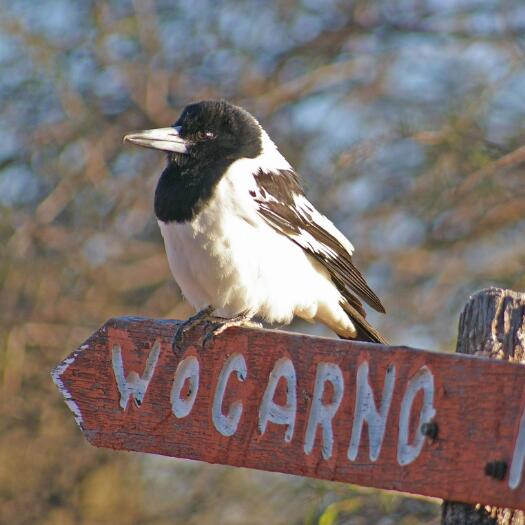 Image: Pied butcherbird at Wogarno Station
 © Photo by Chris Tate
A century ago, poet and musician Henry Tate urged Australian
composers to look to their own musical landscape - to Aboriginal
traditions, to the sounds of the bush, and especially to the
expressive potential of birdsong. Among the voices he singled out
was that of the pied butcherbird (Cracticus
nigrogularis), whose "grave and gentle measure…readily
combinable with other calls in an artistic ensemble" he believed
held great promise (Tate). My new book follows Tate's intuition,
offering more than a hundred transcriptions of pied butcherbird
vocalisations. Some are indeed "grave and of gentle measure," but
many burst with exuberance: timbral shimmer, chromatic twists,
wide intervallic leaps, and daring structural turns.
No two pied butcherbirds sing alike, and each year they develop
and transform their musical identities. Neighbours may craft
entirely different phrases or share parts of their repertoire.
When they do overlap, the shared material ranges from a motif to
entire phrases - but usually transformed rather than slavishly
copied.
Their compositional method is combinatorial. Motifs behave like
snap-together beads: the orange bead might start a phrase, or it
might land in the middle or the end - or even stand alone.
Despite this shifting order, the beads appear at regular
intervals, anchoring the listener. Music depends on pattern and
play. Like most art, it rests on repetition with variation -
repetition that reaffirms, variation that intrigues. Butcherbirds
balance both, offering novelty without overwhelming their avian
audience.
This species has inhabited the planet for some thirteen million
years. The ancient lineage of butcherbirds reminds us that humans
are new on the block vis-à-vis the invention and perception of
melody. Nonetheless, their vocalisations find ample mutualisms in
human sonic structures. For instance, in musical games of the
late eighteenth (and early nineteenth) century, ready-made motifs
were selected by throwing dice, spinning a top, or choosing
random numbers. Known as ars combinatoria, systematic
arrangements of prefabricated materials were well known to Mozart
and Haydn. Beginning with only a few simple component pieces, the
possibilities for combinations quickly balloon (Ratner). In
Musurgia Universalis (1650), Kircher claims that
combinatorics enables a novice to attain compositional skill in a
short time (Knobloch). And if this is true for a novice, what
might it mean for a bird?
My own initiation into their musical world began with failure. In
2001, on my first trip to Australia, I found myself at Wogarno
Station in Western Australia, surrounded by a vocal trio-an
unexpected songbird configuration for me. Their crystalline lines
moved slowly enough for the human ear to follow, yet their
combinatorial brilliance exceeded anything I could quickly
capture on the page. I scribbled down a fragment, but the full
art of their performance eluded me. That moment convinced me that
something extraordinary was happening in their songs, and soon
after, I committed myself to exploring their largely uncharted
vocal culture (Taylor).

Image: Hollis Taylor at Newhaven Wildlife Sanctuary. Photo by
Jon Rose.
For me, understanding pied butcherbird music is founded on
notation. My history with transcription stretches back to 1973,
when I was a classical violinist in San Francisco. A borrowed
cassette of jazz violinist Stéphane Grappelli sent me to the
page, notating his solos. At the same time, I was studying South
Indian (Carnatic) violin with T. N. Krishnan at the Berkeley
Center for World Music, transcribing both the ragas he taught and
the improvisations he spun from them.
That was only the beginning. As my curiosity about the violin's
global lives grew, I discovered how few written resources existed
for many traditions. Oral transmission meant learning by ear-or
transcribing. I confess, I usually chose the latter.
I notated Texas‑style fiddle tunes, eventually becoming the
Oregon State Fiddle Champion, which led to forming bands and
performing widely, including with Emmy and Grammy Award winner
Mason Williams. My path wound through bluegrass, old time,
country, Western swing, Cajun, pop, rock, merengue, Afro‑Cuban
music, Eastern European folk traditions, Moroccan excursions,
jazz clubs across a continent, klezmer, tango …master of all
these genres? By no means. The list is long, but the through‑line
is simple: I became adept not at mastering genres, but at
starting from square one.
Even so, my early attempt to notate pied butcherbird song was
destined to fall short. Absolute pitch and decades of
transcribing unfamiliar human music were not enough. These birds
demand more: patient fieldwork, repeated listening, and immersion
in the voices of many individuals. Only then does their
musicality begin to reveal itself.
Music from Another Species is my zoömusicological
analysis of these avian vocalisations and their resonances with
diverse music produced by humans. These choristers provide a rich
bounty of complex musical phrases to celebrate, and I was hard
pressed to narrow down my list. In this culmination of over
twenty years of recording, I notated 100+ individual
vocalisations over 312 pages.
The collected transcriptions begin with two chapters that feature
side-by-side comparisons of bird solos across geography. The
first one, 'Solo Songs in the Red Centre,' follows the nocturnal
solo songs of fifteen neighbours along 18 kilometres to the east
of Mparntwe/Alice Springs in Central Australia. I enjoy the sonic
treasures of this compact but productive series of field sites.
The following chapter, 'The Neighbours Up North,' details the
2014 singing of sixteen neighbours in the regional North
Queensland town of Charters Towers.
Next, transcriptions from the same site on different years: 'An
Art Star at a Single Site Across Time' follows an individual
singing annually at the Araluen Arts Centre (Mparntwe/Alice
Springs) from 2007 to 2023. 'Additional Solo Songs at a Single
Site Across Time' features annual visits to two field sites in
Central Australia and two in far North Queensland.
Elegant and virtuosic variations between two subspecies of pied
butcherbird populate the next two chapters. My two most
productive areas are Central Australia, in and around the town of
Mparntwe/Alice Springs, and North and Far North Queensland. These
areas encapsulate the two subspecies of pied butcherbird, which
are visually identical (or nearly) in the field. Cracticus
nigrogularis inhabits Eastern Australia, while Cracticus
nigrogularis picatus is found in Central and Western
Australia. The reader/listener can decide whether the songs of
the two subspecies betray marked differences; for me, complexity
more often marks the former, while elegance describes the latter,
although neither subspecies has total purchase on these
qualities.
The final chapter champions ensemble song in its various
outcomes, from countersinging (which may be matched-when a
neighbouring bird preferentially sings a phrase from a common
repertoire that best matches what the other is singing-or
unmatched-when a bird avoids repeating what the other just sang)
to duets and larger groups.
Female song occurs widely across songbirds, especially in regions
like Australia where many species hold permanent territories
rather than migrating. Because female pied butcherbirds are
visually indistinguishable from males in the field, any
discussion of the female vocal contributions remains largely
inferential. Unison duets are uncommon, though the presence of
additional group members can sometimes result in a motif being
doubled. Duetting itself ranges from tightly synchronized,
intricately structured exchanges (hockets) to looser, more
spontaneous interactions with flexible timing (à la Dixieland
jazz). Octave leaps make regular appearances.
Musicians often ask me if pied butcherbirds employ a set scale or
embrace just intonation. It would be appealing to fix them in
such human terrain, but the answer is more complex. When I
investigate and transcribe a single pitched note, the sonogram
often indicates a slight portamento not always perceptible to the
human ear in real time. But to a butcherbird's ear? Some
biologists suggest that the perception of time is up to ten times
more acute in a bird than a human. In other words, the resolution
of a second in our perception might have ten seconds worth of
sonic detail in a bird's. I am notating for humans, so I find
notating on a five lined score (with the occasional quarter tone
sharp or flat) to be more than adequate for these purposes.
Complete with online audio files, outback images, and fieldwork
anecdotes, Music from Another Species opens the door for
composers and performers to discover the enchanting melodies of
the pied butcherbird. These feathered dinosaurs provide a rich
bounty of complex musical phrases to celebrate, allowing us to
immerse ourselves in the musicality and invention of another
species' song culture.
For more information, see: iupress.org/9780253075864/music-from-another-species/
For audio and images that accompany the text, see: piedbutcherbird.com
References:
Knobloch, Eberhard. "Musurgia Universalis: Unknown Combinatorial Studies in the Age of Baroque Absolutism." History of Science 17 (1979): 258-75, pg. 266.
Ratner, Leonard G. "Ars Combinatoria. Chance and Choice in Eighteenth-Century Music." In Studies in Eighteenth-Century Music: A Tribute to Karl Geiringer on His Seventieth Birthday, edited by H. C. Robbins Landon and Roger E. Chapman, 343-63. New York: Oxford University Press, 1970.
Tate, Henry. Australian Musical Possibilities. Melbourne: Edward Vidler, 1924, pg. 20.
Taylor, Hollis. Is Birdsong Music? Outback Encounters with an Australian Songbird. Bloomington: Indiana University Press, 2017.
© Australian Music Centre (2026) — Permission must be obtained from the AMC if you wish to reproduce this article either online or in print.
Subjects discussed by this article:
Violinist/composer and ornithologist Hollis Taylor performs her (re)compositions of birdsongs along with her environmental field recordings and also recasts birdsong for other musicians. In addition to her CD Absolute Bird, she authored Music from Another Species: Australian Birdsong Transcriptions, Is Birdsong Music?, and Post Impressions: A Travel Book for Tragic Intellectuals. She received the 2025 Richard Gill Award for Distinguished Services to Australian Music.



Comments
Be the first to share add your thoughts and opinions in response to this article.
You must login to post a comment.