22 April 2026
Reflections from Classical:NEXT 2026
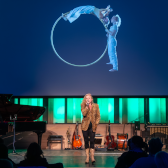 Image: Chloé Charody introducing "LIMBO - a sonata for acrobatic violinist" performed by Sonja Schebeck, Josh Frazer & Chanda VanderHart at Classical:NEXT 2026
 © Christoph Mangler
I've just landed back in Australia, still a little jet-lagged, still buzzing, and still processing the incredible time I had at Classical:NEXT in Budapest last week.
I was lucky to be chosen as the fellowship recipient for Australia as well having the opportunity to showcase my sonata for acrobatic violinist LIMBO to a packed concert hall at the Budapest Music Centre. The incredible acrobatic violinist Sonja Schebeck, acrobat Josh Frazer and pianist Chanda VanderHart took to the stage to showcase this piece that we have had on tour throughout Europe for the last 3 years.
As the composer and co-creator of LIMBO, I find it a pretty intense experience watching Sonja and Josh's sometimes death-defying acrobatics play out on stage as we tell the narrative of the work through the fused medium of the violin sonata and partner acrobatics.
There are always moments throughout the performance where I
wonder how Sonja will land, something that I find especially
nerve-wracking in a room filled with some of the most discerning
and forward-thinking ears in the industry. LIMBO is not a safe
piece. It is a piece that pushes the boundaries of how far we can
take this new medium we are developing. The work lives in
instability, demands a huge amount from its performers (and
perhaps even more of its audience!). So, when the final moment
landed and the room rose to its feet, I felt something shift in
me.
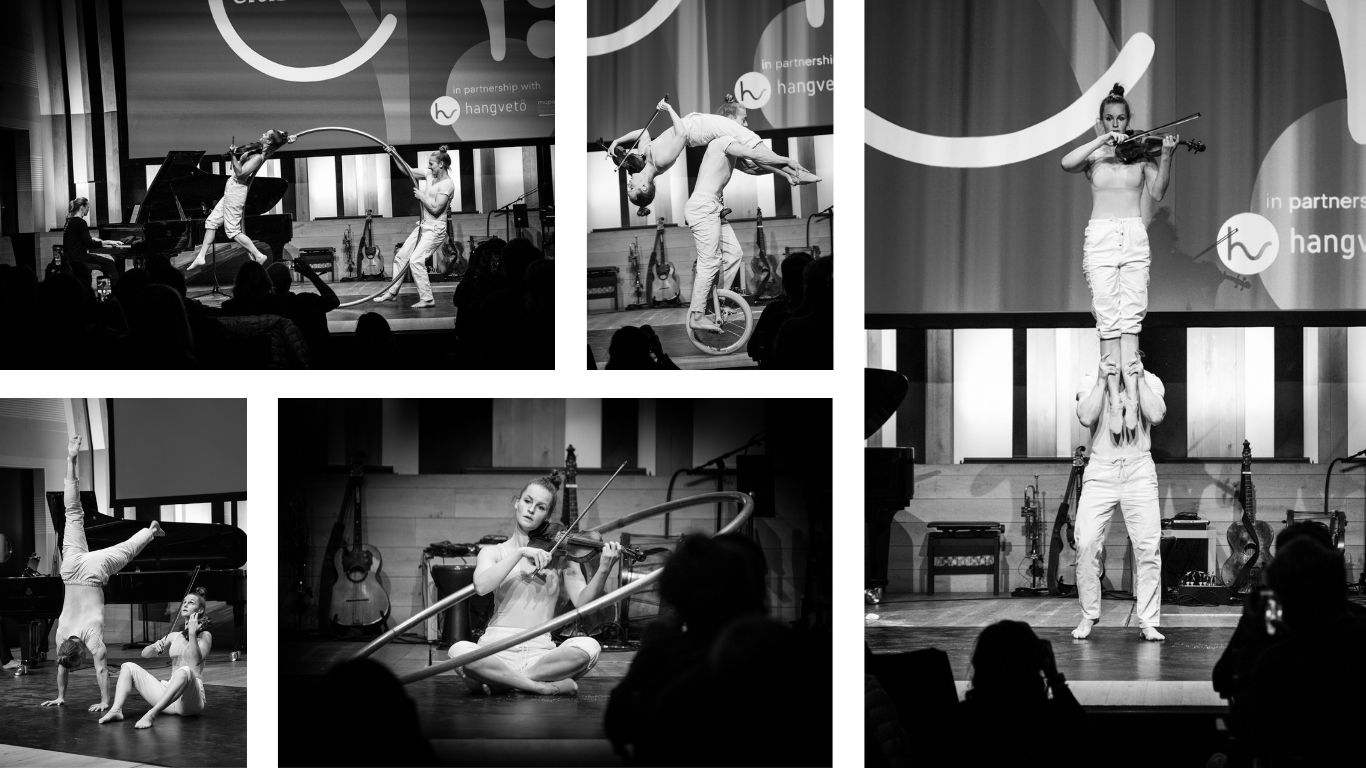
[Photos: LIMBO - a sonata for acrobatic violinist composed by Chloé Charody and performed at Classical:NEXT 2026 by Sonja Schebeck, Josh Frazer & Chanda VanderHart. Photos by Ory Schneor Photography]
The standing ovation was deeply humbling. Not just as a personal affirmation, but as a signal that there is space, real, tangible space for work that sits between forms, that challenges expectations, that invites audiences into something unfamiliar. It was a reminder that risk, when held with clarity and intention, can resonate far beyond what you anticipate.
And I have to say, I felt like it was this point that was a driving force of the whole Classical:NEXT event. There's something quite electric about being in a space where the future of classical music isn't just discussed, it's actively being built, challenged, and reimagined in real time. Classical:NEXT isn't just a conference, it's a convergence point for people who are deeply invested in where our art form is heading. Composers, presenters, orchestras, ensembles, producers, and inventive performers all gathering with a shared sense that classical music is far from finished, it's evolving.
I think one of the most valuable aspects of the experience was connection. In the span of a few days, I found myself in conversations with arts organisations looking for bold new work, orchestras eager to rethink programming, and independent ensembles carving out entirely new performance models. These weren't surface-level exchanges either. There was a genuine openness, a willingness to engage deeply, and a sense that collaboration across borders is not only possible but necessary.
What struck me most was how many people are operating at the forefront of creative innovation. There's a collective appetite to dismantle the old binaries like high art vs low art, concert hall vs theatre, musician vs physical performer, and to rebuild something far more fluid. I saw works that integrated movement, technology, installation and ritual. I saw artists questioning who an audience is, and where a performance can live.
To witness so many artists pushing classical music into completely new and undiscovered territory was genuinely thrilling. Not everything was "polished" in the traditional sense, but that's precisely the point. There was risk and vulnerability. There was experimentation that sometimes teetered on the edge of collapse, and that edge is where the most exciting work seems to be happening right now.
I've come away from Classical:NEXT feeling pretty excited to know that there's a global community out there that is hungry for evolution, for collaboration, and for work that dares to ask different questions.
A HUGE shoutout of thanks has to go to Larry Heath from Sounds Australia and Cath Haridy from Australian Music Centre who were our reps at the festival and were such a massive support not only to me, but to all the Aussie delegates that came to the event. To anyone wanting to be a part of the future of the international classical music world, Classical:NEXT is where you need to be.
© Australian Music Centre (2026) — Permission must be obtained from the AMC if you wish to reproduce this article either online or in print.
About the Author
Chloé Charody is an internationally renowned composer, show creator and refugee supporter celebrated for her unique sound world that fuses lyrical intensity with bold genre-defying experimentation.
Widely regarded as an artistic entrepreneur as much as a composer, she has forged a new path in classical music by seamlessly integrating the physical language of contemporary circus, depth of classical music and the drama of opera within her compositional craft. Chloé’s work has been said to dissolve traditional boundaries by treating movement, spectacle and experimentation as intrinsic musical elements.
Chloé is an AMC Represented Artist.
Comments
Be the first to share add your thoughts and opinions in response to this article.
You must login to post a comment.