9 September 2026
t[w]o islands many Irelands: hybrid navigation in music and words
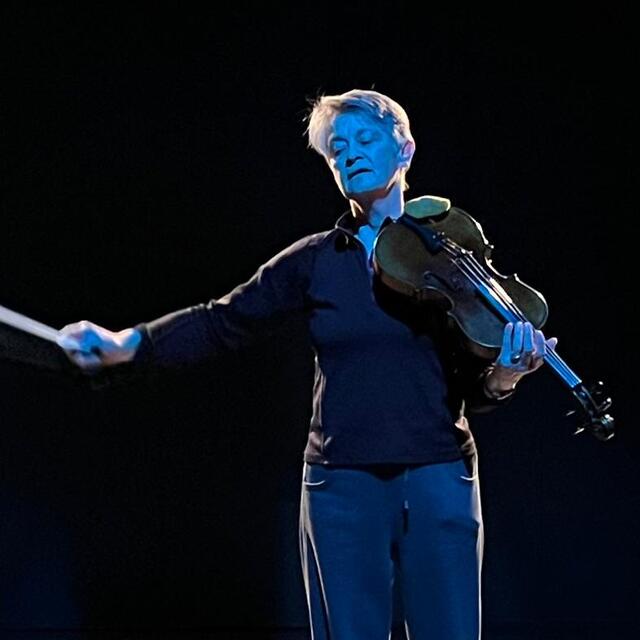 Image: Andrea Breen
 © Photo supplied
(It is recommended to listen to t[w]o islands while reading the following)
When my sister Andrea Breen announced the release of t[w]o islands (2021), the visual play on words represented more than its parts.i The announcement's principal energy derived from the sounds she had made with the music. Before the words came the music. Combined, words and music, music and words, formed a creative cycle of cognitive necessity in both hemispheres of the brain.
Located in another 'hemisphere', south of the southern in the Tasmania of her adopted home, her place of residence remains an antipodean curiosity at the end of Australia, the massive island-continent that is our shared place of birth. Tangentially west across the South Pacific from the two islands of New Zealand then north of Antarctica, Tasmania is a part of Australia. It is not 'The Mainland', as many geographically inclined, regionally sensitive people in Tasmania attest.
With t[w]o islands she skipped the mainland, moving the musical language of her composition to sonically connect Tasmania with the ancient sounds of a green island located off mainland Europe, not quite true north of the northern hemisphere: Ireland.
Two islands of land mass, except Andrea projected the unsteady sonic registers of our bloodlines snaking across oceans and under water, through the gravel pits of time. The bow across her viola, the rasp of her voice registering like the pebbles in pits, combined. Through generations of hybrid connectivity, vibrations meeting rough edges reconciled the separation, loss and despair, emerging smooth edges of joy, pleasure birthing unsettled contentment: an alchemy of Ireland on another island.
The grains of worlds combined in mixed metaphors of materiality: land, islands, water, oceans, gravel, stones and pebbles. Condensed in representation, refining old questions, generating our "Diasporic sense of self".ii
What imaginary would turn the rattling convict chains in Van Diemen's Land into the aural texture of the history of two islands? What comatose resonances, otherwise squared away, were revealed as musical truths in the contorted history of settler colonialism? Would a liminal space of quavers beating between two island masses open up? Could the vibrations intimate what the words tell?
The music worked, even as it demanded the labour of listening, as if it was revealing rough stones over time, now rotating in a tumbler, becoming pebbles. All while the pit of history gave itself up to the Andromeda-effect of the hazy past. Billions of smoothed out objects in a cosmos of connected migration, like stars fading into fuzzy distance.
At points it moved backwards into Indigenous foreknowledge.
For whom the bells? Tolling for knowledge of an island/Ireland, settler reconstruction within colonial deconstruction. Indigenous debasement.
Growing up in Australia, we believed that we knew the unspeakable in the political economy of the convict. "Belief," fearful of the Scare Quotes.
Confidently, she leads us to the other name: Tasmania as the island harking back… to lutruwita then forward to Ireland, to a state of being about Irishness, caught as it were, by the Red Right Hand of multiple meanings, a polyphony of struggles over consciousness.
"And around and around it goes:" certainly, or do I mean certainty? Paul Robeson sings against the global grain of our self-destruction before the sound pitches in for a reminder of an uncertain past - unalterable vibrations engendered, conscious construction of pasts foreclosed before they opened on this little tract of land just above the penguins.
Strings pulled in thrumming beats of the heart, the liver and other organs. Music? Is a discord a note? Grate against the grate of the great, as it were.
I cannot recognise my sister, when I know it is her. It sounds as if she refused to tune the strings, searching inside cavernous places between two faces in spaces where she connects what we cannot say as easily as we would like. Words fail me on hearing intentional constructions improvised against and with the winds of coastal Tasmania and the Cliffs of Mohar. The "intentional hybridity" of unmaking the made.iii
The seaweed off Tasmania's west coast is twenty metres long, folding in on blue water - as long as the sky remains unclouded.
Our parents' parents and some of their parents farmed in Ireland. They moved to Australia.
Memory shifts its layers of sensation.
She could be walking the donkey to the thatched roof home, stones clacking on hooves beside a rock wall. The Banshees of Inisherin replay of cinematic anguish adds to the connotations of lustre in my mind. Colored pastures to the left and right, thoughts hazy as if there is nothing in the world that's too big. The donkey sighs. History placates no one.
Where is home? It is a pointless question amid the sound of musicianship. There is there and there is here and then there is us. She was in Ireland, Donegal, Australia, and Hobart. I am in Boston, Massachusetts. That's material to the sensibility of living Irishness.
The ghosts in her machine, in which the infernal racket becomes loss. While what was once lost is found. A computer recalls the shared waves in the background of our minds, driven by American technology in a silver case. Apple fell from the tree before Eve heard the hooves on the paving stones.
Sounds reference, calling us like a Selkie. Plural Selkies. Many transformations immutably cast in soft displays, vibrating in what was once and forever was and shall be, or whatever that text says it was. Near a furnace, the convicts had no dreamtime Selkies. After a thousand bricks cast in Hobart-town clay, they find the native inhabitants curious. Men and women forced away from home, say County Clare, or Mayo, or another a Gaelic memory place, trade tobacco for a dead kangaroo.
Walter Benjamin looks up. He likes what he hears because he loves the knowledge of dialectics. Even with puppies barking in the yard the library is too quiet. He decides to wait. Spain too far away. The sounds bring people whom he loves. We remember our fathers.
In my stomach, wheels feel like they are rolling over the floor of the Tate Modern. On the up escalator, moving toward Mark Rothko's canvas Light Red Over Black: hoping the couch is free to give us time to reflect on Ireland as our home, our island home, as Christine Anu sang about the Torres Strait, or Tasmania. Islands common yet different.
Too much geography? Circle back to the stones being smoothed. Direct connections fail like bad writing before indirect connections make it better. In music, chords in a transparent form of beauty join us together.
Music and words reverse the Australian singer-songwriter Paul Kelly song title "Words and Music."iv No one notices until they are shown the remit, reworked in solemn ignorance. They nod as the band stops, realising as they stare into the sun that the band was never there. Everyone misses Steve Connolly, his father Keith and his mother Jo. Viva Cuba!
The stones keep rolling at the bottom of the ocean, offering a coarse churn below the radiating surface. A rumbling. Bagpipes play a temporary march, while the stones shift again. Slowly smoothing. One day we will all be smoothed, in "a kind of resurrection."v
If a lullaby is a song for a baby, can a baby be a song?
Who makes onion soup in a ladle?
When does a non sequitur about a place make sense?
"Sense of place" is an oxymoron as long as the moron is me. This kind of self-hatred emerges from too much ignorance of the munificence of songlines.
We return to Andrea's attachment to the question, what's to be heard? A million lines of code, in a billion convict genes. None of them ours. The moral universe is always obtuse until it is sparkling in perfect unison with an assortment of Irishness.
That's after the chainsaw. "Cousins" make a living cutting down old growth forests in Tasmania. In Ireland "cousins" are reforesting. Bells ring for the end and the beginning, contradictions moving on in a virtuous cycle of bricolage.
Her "willful subjectivity" is her social relations in two places and between them.vi I can sense her will at work. Imagineering, making the instruments sound out, unmaking them with digital engineering, connecting with the state of things, asking for our ears. Working with others in Hobart, The Burren, and Belfast.vii Stopping to make sense of our cousins in County Derry: they add London as a prefix. Tension rises like Oliver Cromwell from his grave.
See her making the music. Photographs of instruments, art galleries, installations carry floating weight. Look at her web pages. Listen on Band Camp. Proud that her response to the Irish of our world exists.
The bells begin, again. There are voices, I hear voices, before then after clanging, horse hair across the strings as a unstable semblance of otherness, between nowhere on this island and somewhere on that one, torn between, torn by, before the certain urgency of betwixt and between.
Children! Or is it possums in the rainforest? The primordial sensibility gushes out like steam released under pressure. It can scald and it will burn. Our senses remind us of connections made by music that find the lizard brain, snuggle into a cavity to look out, like a lizard.
Andrea posts to me and my partner Deb in Boston, a book of poems titled t[w]o islands.viii Another record of her intrepid navigations. I am searching for a coherent theory of being social. Reaching, the music distends itself into verbiage, as if another synapse has emerged, bridging island and Ireland with concrete hardened by Hobart's limestone, dug, mixed, placed between bricks by convict muscle. It is a long way from home where the gap never closes.
She writes: "burren september"
listen [at an irish education symposium]
here a tower stands
pushing presence at a slate sky
holding rain for now
I stall above the permanence
festooned in green mould
then grey
my footstep tilts on stone
beside pools like tears
across the shelf
The lingua franca of Ireland juxtaposes Tasmania as an island in an incomplete construction. Australia pushes itself away to get closer: intentional Irish hybridity vivified.
After reading a draft of this response to t[w]o islands,
Andrea replied with notes and comments, thanking me for my work,
adding:
I did follow up t[w]o islands (2021) in 2025 with Palimpsest-As-Process (same gallery),
and feel as if the palimpsest is inexorable!
Everything feels layered.
Layered! Is this the nomadic mind of the sojourner processing the homelessness of home? The Irishness of Tasmania found on a remote island.
Wanting language precision I looked up palimpsest in the 1982 Pocket Macquarie Dictionary that I keep on my desk. It is not listed. Did the word have no traction in Australia in 1982, the dictionary's year of publication?
Online, the Google dictionary defines palimpsest in 2026 as: "a manuscript or piece of writing material on which the original writing has been effaced to make room for later writing but of which traces remain.
something reused or altered but still bearing visible traces of its earlier form."
Lower on the page, after a graph illustrating increased use of
the word between 1800 and 2019, the etymology about palimpsest
is:
"mid 17th century: via Latin from Greek palimpsēstos, from palin 'again' + psēstos
"rubbed smooth."
Use over time for: palimpsest."
Earlier I referred to the stones of Tasmanian Irish Irishness smoothed in a tumbler, a shoddy metaphor I struggled to construct in explaining the process of music and words informing t[w]o islands. I selected the metaphor because it was the best that I could do at that time. Perhaps "my best" was accurate after all? (Protestant self-doubt never leaves.)
Andrea's palimpsest performances were improvised. Made then gone.
As far as I can tell there is no record of them in the endless
reservoirs of digital recordings with which we live. Here is what
the publicity for the 2025 show said:
Palimpsest-as-Process by Andrea Breen questions the processes of art-making, in the gallery and by showing work that has already been 'transformed'.
Palimpsest-as-Process will interrogate how we make decisions around discarding or reinventing art & how art practices might celebrate the processes of creativity. Andrea Breen has spent the past twelve months re-inscribing & reimagining extant texts from her oeuvre of previously shown creative work, including paintings, collages, drawings, poetic texts & acoustic compositions.
The exhibition will include sound installations (in the gallery space and on headphones), and "in-gallery" change processes. Visitors will be invited to offer contributions.ix
The change process - found, made, uttered and not retained, not like an anchor, halting progress.
The materiality of living rubs everyone smooth, where the music and the words improvise the permanent system of struggle for the meaning of Irishness.
- i Andrea Breen, t[w]o islands, (2021) https://andreabreen.bandcamp.com/album/t-w-o-islands ↩
- ii Fraser MacDonald, "Losing our Religion," in "Scotland," Edited by Kathleen Jamie and Don Paterson. Irish Pages, 12: 2 (2025): 111. ↩
- iii Pnina Werbner, "Foreword." In Editors Laura Pops and Roeland Goorts, Cultural Identities in a Global World: Reframing Cultural Hybridity. (Berlin, WVT Wissenschaftlicher Verlag Trier, 2024), 1-3 (1). ↩
- iv Paul Kelly, "Words and Music." Lyrics at Paul Kelly (1997). https://www.paulkelly.com.au/lyric/words-and-music/ ↩
- v Richard Murphy, "Poetry and Terror: love over terror," review of North by Seamus Heaney. Irish Pages, 8: 2 (1976/2014): 142-152 (148). ↩
- vi Ernst Fischer, The Necessity of Art: A Marxist Approach. Translated by Anna Bostock. (Harmondsworth, Penguin Books, 1963): 191. ↩
- vii Tracks collated for "t[w]o islands: a bricolage," a multimedia installation at Salamanca Arts Centre (Tasmania), July 2021, gleanings from Ireland & lutruwita/Tasmania. Improvised & gathered sounds mixed in studio credits released July 15, 2021. Electronics, field recordings, viola, ruined piano, toy piano, low whistle, voice, sound design, mixing: Andrea Breen with Emily Sheppard violin (15 & 17), Anne Norman Shakuhachi (15). ↩
- viii Andrea Breen, t[w]o islands, (2021, Bluerobin productions). https://www.andreabreen.com/ ↩
- ix Andrea Breen, Palimpsest-as-Process. (Salamanca Arts Center, 20-25 August 2025) https://www.sac.org.au/events/palimpsest-as-process/ ↩
© Australian Music Centre (2026) — Permission must be obtained from the AMC if you wish to reproduce this article either online or in print.
Subjects discussed by this article:
Marcus Breen was born in Melbourne, educated at The University of Queensland, The Australian National University and Victoria University of Technology. He moved to the US in 1996 and since 2014 he has been a full-time faculty member of the Communication Department at Boston College. He has taught cultural, media, popular music studies at The University of Melbourne, The University of North Carolina at Chapel Hill, Northeastern University, and Bond University.


Comments
Be the first to share add your thoughts and opinions in response to this article.
You must login to post a comment.