1 June 2026
The Maria Anna Mozart Concert Tour
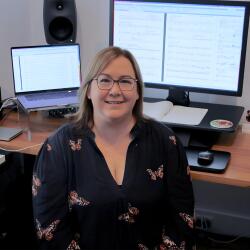 Image: Jessica Wells
 © photo supplied
In 2024, I was privileged to be asked to score the documentary Mozart's Sister, created by Australian film company Media Stockade. This year we bring the music, images and story of the film's heroine Maria Anna Mozart to live audiences across Australia as part of the "Maria Anna Mozart Concert Tour".
Mozart's Sister takes a deep-dive into the story of Wolfgang Mozart's older sister Maria Anna, and why, until now, relatively little has been known about her life and music-making. In her early years, Maria Anna was taught to play the keyboard by her father Leopold, who recognised her prodigious talent and took both Maria Anna and younger brother Wolfgang on a lengthy European tour to perform in front of dignitaries and supply the family with an income.
During their European tour, at ages 13 and 8, the siblings wrote Symphony No.1 in E-flat K16, which is attributed wholly to Wolfgang as his first symphonic composition. However, the truth is that Maria Anna wrote it all down, and at the ages of 13 and 8, we now have the insight that she was most likely more than just a transcriber! She was an active collaborator who at minimum orchestrated the score, and the second movement shows such maturity that it calls into question how an 8-year-old would achieve this singularly.
At the age of 15, Maria Anna was tragically retired from performing due to societal constraints upon women at the time forcing the family to focus their efforts on Wolfgang. In letters written between the siblings it was clear that she was still composing music. The film investigates these letters and goes on to look at other female composers of the time and how they may or may not have been successful in publishing or getting their work performed.
In the 1800s, Fanny Mendelssohn was only able to publish her compositions under her brother's name. Women composers have struggled to have their voices heard ever since music has been written down, but have sometimes found ways to be recognised via covert means such as this. Or, as discovered in the film, cloistered away in a nunnery on the hill in Salzburg, nuns were composing and performing on banned instruments such as cellos and bassoons, hidden away from sight of the patriarchy! In 1986, Peggy Glanville-Hicks was quoted saying "A lady composer has to be twice as good as her male competitor to win a prize or get a grant" (1986).
I myself was berated online by an older male composer for receiving a BBC Proms commission in 2018 (for a 5-minute solo work not an orchestral score!) because I had only received the commission due to my gender and I really didn't deserve it! (The online response from my community to the backlash was wonderful and I did feel that he was not representative of the Australian music scene in general, but it was shocking to hear this sentiment when the BBC was making efforts to address their long-time failure to women composers over their history).
The film interviews many prominent women in music to discusses gender discrimination in classical music as a veritable 'ice age' that occurred when orchestras and ensembles started to lean back into history rather than celebrate the new, active creation of music.
Gabriella Di Laccio founded the Donne Foundation for women in music in 2018, and began to analyse the performances of orchestras worldwide to find staggering statistics: 92% of all repertoire performed is written by men, 80% by dead men, and of that, 30% are compositions written by the same 'top ten' dead European men.
Gabriella is interviewed in the film and explains that we don't want to diminish these great works, but we need to make space for representation of what is being written today and to celebrate the voices of our time.
In that spirit, The Maria Anna Mozart Concert includes historical music AND music of our time! It features an engaging format for audiences to hear the story through the voice of a narrator and view stunning montage images from the film that relate to each piece of music performed live by the orchestra. My original score was recipient of an AACTA award for best music for a documentary in 2025, and it features 'easter eggs' of Mozart throughout as well as more modern film-score styles that enhance the mood of mystery and investigation.
The centrepiece of the concert is Mozart Symphony No. 1 in E-flat K16, accompanied by a re-enactment of two children joyfully composing together. This frames this piece in an entirely new context - with Maria Anna as a true collaborator and illustrating the close relationship the siblings had throughout their lives.
Bringing this music to
new audiences has been a joy so far, with many concert-goers
appreciating the combination of old and new, of storytelling in
an engaging way, and of the topics they can discuss around the
dinner table, especially to the younger generations of
musicians and composers who want to see themselves in the
future as being valued for their voices, no matter what their
gender.
The Maria Anna Mozart Concert tour is supported by CreateNSW, Minderoo Foundation, good.film, Media Stockade, Jigsaw Music and partner orchestras. Sydney Youth Orchestras present this concert at the Sir John Clancy Auditorium, UNSW (Sydney) on 20 June 2026 at 4pm. Further performances by Central Coast Symphony Orchestra and Sunshine Coast Symphony Orchestra will be presented in the second half of the year.
© Australian Music Centre (2026) — Permission must be obtained from the AMC if you wish to reproduce this article either online or in print.
Jessica Wells is a versatile composer, orchestrator, and arranger for concerts, films, theatre, and album recordings. Her score for the documentary Mozart's Sister has been received to critical acclaim and won an AACTA Award for Best Original Score in a Documentary in 2025.


Comments
Be the first to share add your thoughts and opinions in response to this article.
You must login to post a comment.