12 May 2026
Hear Us Now: Three new works for solo viola
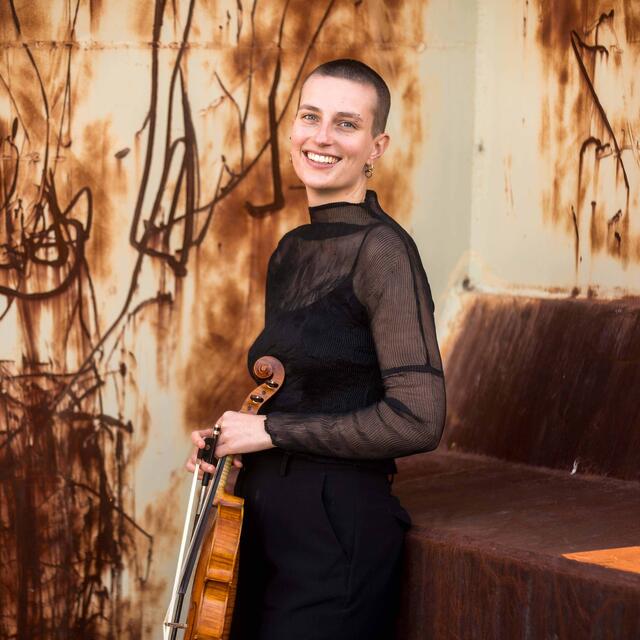 Image: Ella Beard
 © Alastair Bett
Content Warning: this article contains discussions of
childhood sexual abuse and child abuse.
If you need support, please contact Bravehearts or 1800RESPECT
I first had the idea for Hear Us Now in early
2021, shortly after my former high school music teacher was
sentenced for the sexual abuse he committed against me when I was
his student. In the aftermath of this experience, I went looking
for music that directly spoke to what I was experiencing. I hoped
to find something that understood the confusion, grief, anger,
shame, numbness, and isolation that followed.
I found a review of an opera about PTSD following sexual violence, and a symphony that had been titled #metoo before being renamed to make it more programmable. However, I couldn't find anything I could listen to or play.
For several years, Hear Us Now remained only an idea, sitting quietly at the edge of my performance practice as I built a career in classical music. But the longer I spent in rehearsal rooms and concert halls, the more impossible it became to ignore how deeply our artform is shaped by stories we would now recognise as abuse, exploitation, or coercion.
I think immediately of Tchaikovsky and his nephew, of Bartók's marriages to teenage students and of Britten's relationships with adolescent boys. These stories were often framed to me as romantic, tragic, or artistically generative. I was asked to imagine the ecstasy of a composer "falling in love", or to celebrate him as a queer icon, so as to improve my performance.
What was missing, always, was the perspective of the young people themselves.
Of course, these composers are of a different time, and scholarly interpretations of their relationships vary. We cannot fully know what existed within those private lives, especially without the perspectives of the young people involved. I don't think it's particularly useful to condemn these men for their actions without considering the cultural context to which they belong, nor do I think we should renounce the artworks they have made altogether. But I don't think romanticising the past is a neutral act.
Our cultural understanding of power, consent, love, safety, and exploitation has changed. It is okay for us to feel discomfort when historical figures fail to align with those values. It is okay to continue loving the music while grieving the harm that may sit beside it.
Holding this conflict is an essential skill for us to practice. Childhood sexual abuse is horrifying, painful and frightening to engage with, and for many good people I think it is overwhelming; they look away because they cannot bear it. I think classical music often does the same thing. We look away because we are afraid of what we might find: that we feel differently about the artwork, that our artform might be destabilised by contemporaneous values, or that we will lose something dear to us.
But abuse depends upon silence. It depends upon reverence, minimisation, and our willingness to look elsewhere. Only when we look something in the face can we change it. It matters whose stories we tell.
Hear Us Now is my attempt to contribute, in some small way, to balancing the stories classical music tells about abuse. I wanted to create music that speaks from the perspective of victim-survivors; music that does not aestheticise abuse, but instead honours the emotional realities that follow it.
Working with composers Robert Davidson, Hilary Kleinig, and Emily Sheppard, the project has resulted in three new works for solo viola. Each piece emerged from my Victim Impact Statement and from our conversations about the emotions threaded through it that are so common to victim-survivors of abuse: confusion, shame, fear, numbness, anger, tenderness, grief, gratitude, and hope.
Robert Davidson's Isolation moves through rapidly shifting emotional states, circling repeatedly around a recurring melodic motif that transforms in meaning each time it returns. Hilary Kleinig's Hear Me Now is both gentle and unyielding: an articulation of anger, resilience, and contradiction, capturing the simultaneous experience of feeling diminished and powerful, silenced and expressive, fractured and remade. Emily Sheppard's May these sounds bring you home traces a journey through confusion, fear, loneliness, shame, and rage before arriving, tentatively, at love, grief, and hope. It draws upon local and global musical influences, drawing attention to how widespread these experiences are.
I hope these works allow victim-survivors to feel recognised, reflected, and held. I also hope they invite audiences into a deeper, more empathetic engagement with experiences that are too often hidden, sanitised, or dismissed.
And finally, to my fellow victim-survivors: you matter. Your story matters. I hope this music helps you feel held.
Hear us Now.
© Australian Music Centre (2026) — Permission must be obtained from the AMC if you wish to reproduce this article either online or in print.
Subjects discussed by this article:
About the Author
Ella Beard (they/them) is an Australian violist and teaching artist based in London whose work centres new music, community connection, and social impact. They have performed with organisations including Queensland Symphony Orchestra, Camerata - Queensland’s Chamber Orchestra, Bang on a Can, and Wigmore Hall, and work extensively in community music practice. In 2026, Ella will premiere Hear Us Now, a new project for solo viola exploring victim-survivor perspectives.



Comments
Be the first to share add your thoughts and opinions in response to this article.
You must login to post a comment.