9 June 2026
The Rosenberg Museum - reimagined instruments and a new audio collection
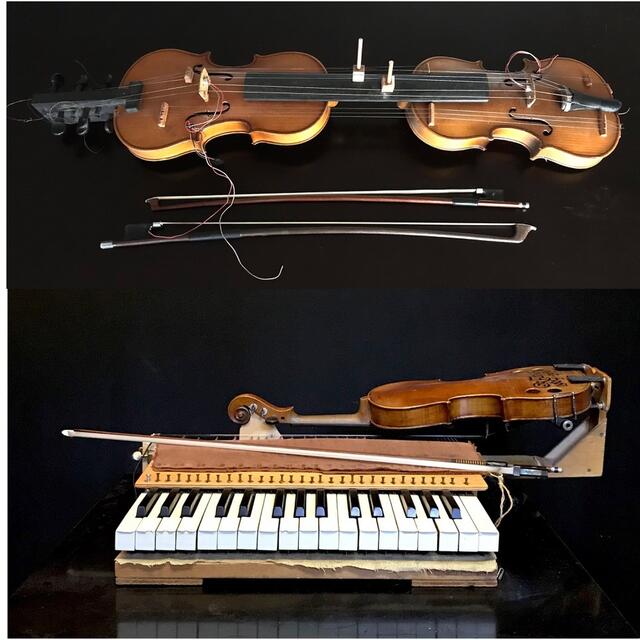 Image: Instrument in The Rosenberg Museum
 © Jon Rose
Documenting five decades of sonic innovation and drawn from The Rosenberg Museum's extraordinary collection of 65 playable instruments and more than 1,000 artefacts of violin iconography, "The Rosenberg Museum box set" offers the most comprehensive audio portrait to date of Jon Rose's restless, boundary-breaking practice.
Founded as a conceptual extension of the violin itself, The Rosenberg Museum has evolved since 1976 into a living archive of homemade instruments, hacked string technologies, cultural detours, and improbable sound-making devices. After decades of itinerancy, the museum found a permanent home in Central Australia in 2021, where Rose continues to build, repair, repurpose, and perform with his ever-expanding menagerie of sonic objects.
Read on to hear more from Rose, The Rosenberg Museum and the recent four-disc audio collection it inspired.
The Rosenberg Museum - an incomplete
catalogue.
The Rosenberg Museum did not begin as a room, or a building, or
even a plan. It began as a question: What else can a violin
become? From that question grew a lifetime of improbable answers
that I'm still dealing with - answers made of wire and plywood,
of fences and wind, of cardboard tubes and washing machine
motors, of sympathetic strings and unsympathetic landscapes.
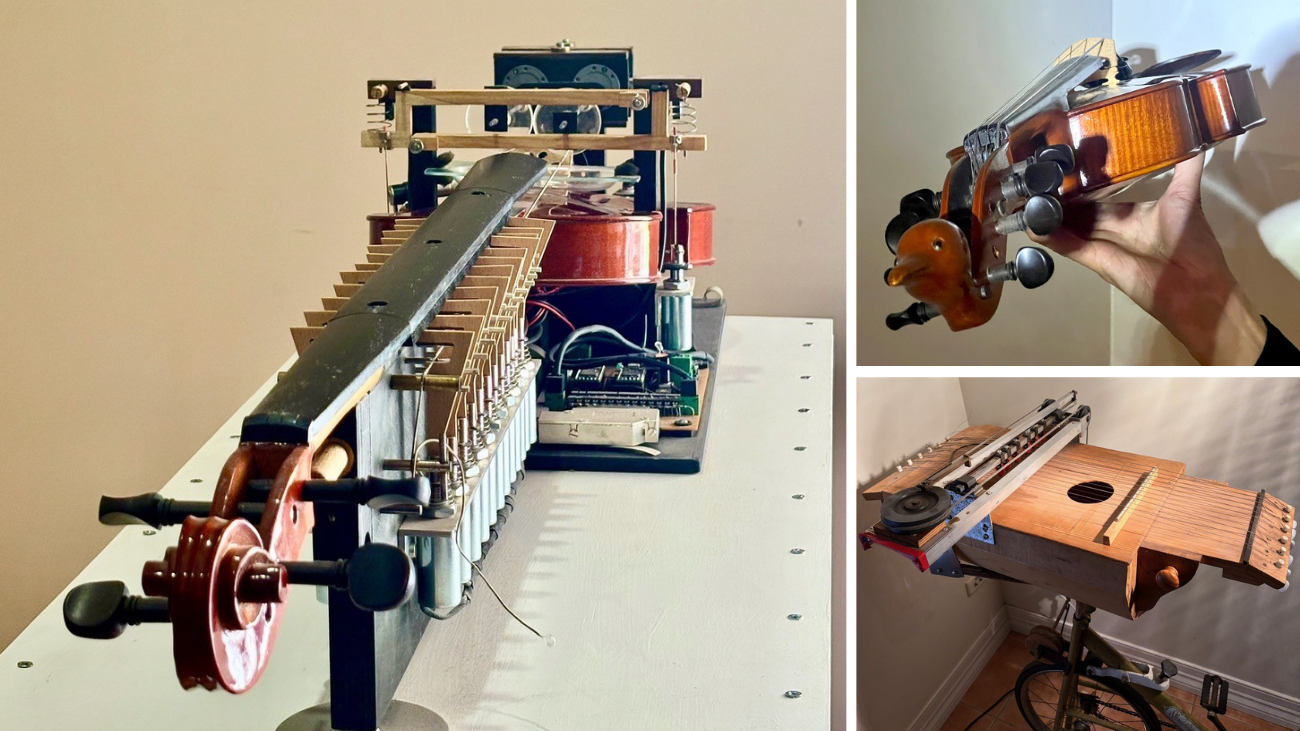
Images: Instruments in the Rosenberg Museum by Jon Rose
The museum is the long echo of that question, a place where the violin explodes into its possibilities - a Gesamtkunstwerk. The museum is not a mausoleum of instruments but hopefully exists as a living organism, shedding skins, sprouting appendages, losing pieces to entropy and theft (hard to imagine but true), gaining alternative instruments and practice through accident, curiosity, or necessity. It is a museum only in the sense that a river is a container for water: always moving, always changing, always carrying material and ideas forward.
When the project began in 1976, resources were few, but luckily my imagination proved reliable enough. The violin - already five centuries old - became a portal rather than a prescription. If the world could be bowed, why limit oneself to spruce and maple and four strings? Why not bow the detritus of civilisation, the leftovers of industry, the bones of cultural infrastructure? When I think 'violin', I don't think instrument but generic resource.
A new instrument works the physics. It produces by definition a
sound that has never previously existed. The moment a string is
stretched across an object that was a stranger to vibration, the
world of frequencies expands. That moment - brief, fragile,
unrepeatable - is the museum's true foundation stone. Other
cultures, techniques, histories could be adjacent, but that
singularity of exploration is magic.
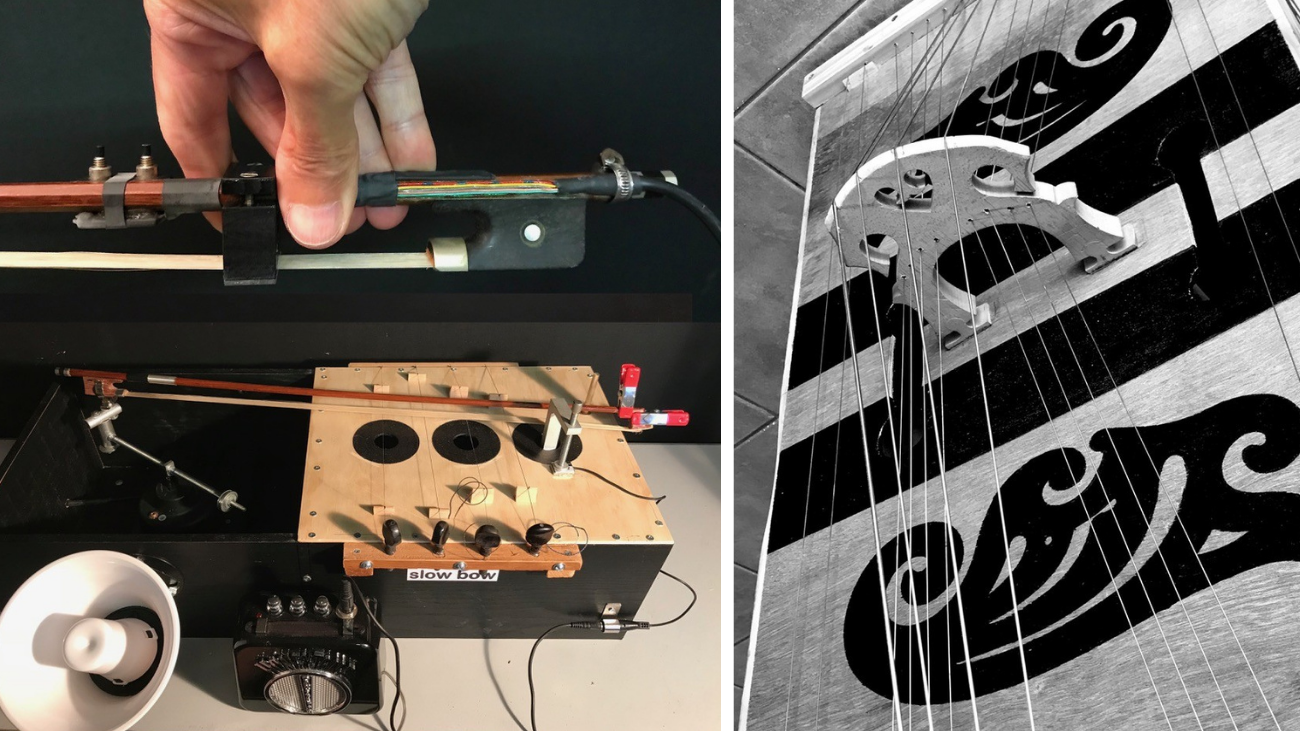
Images: Instruments in the Rosenberg Museum by Jon Rose
Over time, the collection grew. Last year I counted 65
playable instruments, a thousand artefacts, and countless stories
- some true, some fabricated, all resonant. The museum wandered
for decades, an itinerant caravan of sonic experiments, until it
found its unlikely home in the centre of Australia. Here, in a
landscape older than human music itself, the instruments finally
settled.
Central Australia offers its own tuning systems: wind that sings
through wire, insects that improvise in the dusk, fences that hum
like low brass, and a cultural understanding - ancient,
continuous - that nothing is truly inanimate. Rocks, rivers,
animals, kinship lines: all part of a living continuum. In such a
place, the museum feels less like an eccentric personal
collection and more like a natural extension of the land's own
acoustics. If not here, then where?
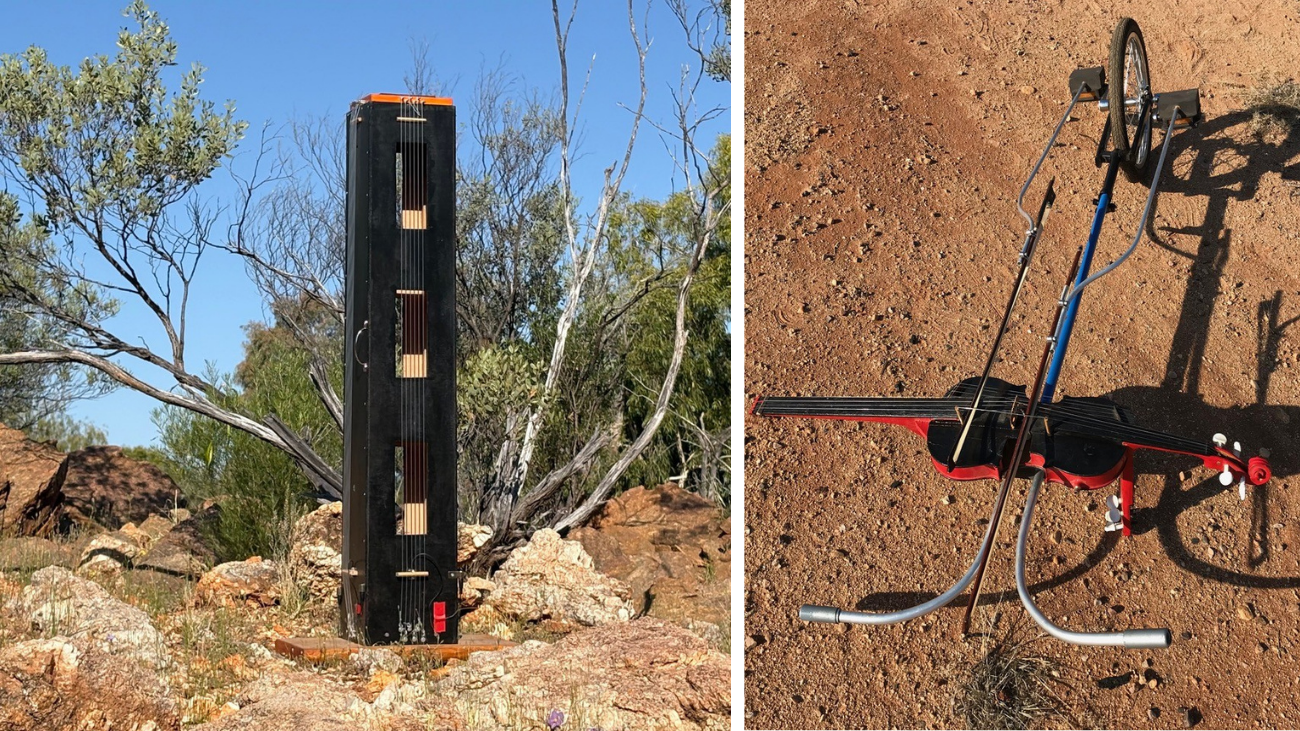
Images: Instruments in the Rosenberg Museum by Jon Rose
The instruments themselves form a kind of parallel evolution. Some are descendants of the violin; others are evolutionary leaps sideways. Some are built for the hand, others for the wind, others for motors, wheels, or the unpredictable behaviour of weather. Some are played once and never again; others return in new guises, repaired and often in new tuning regimes.
There is something of the one-man band in many of the instrument's physical demands, something of the Futurist orchestra in their mechanics. What is more interesting to the creator, a junkyard or an antique shop?
This four disc collection (box set) documents the museum's shifting preoccupations: the drainage pipe that became a resonant column; the cardboard tube that became a crank-driven scale; the fence that became a string quartet; the washing machine that became a percussionist; the violin that became a wheel, a robot, a web, or a musical map of the outback measured not in minutes but in kilometres.
With each instrument, I'm reminded that music is not a fixed tradition but a renewable resource, waiting to be activated by curiosity, by touch, by wind, by accident, by the stubborn refusal to accept that the world of music has already said everything it can say. And I still do enjoy playing the plain vanilla instrument for what many consider it is… arguably the definitive icon of Western music (the piano is something else, you can't run the history of western music without that).
When I mentioned in 2014 that I was collaborating on an improvised violin concerto with Elena Kats-Chernin, I was greeted with some surprised looks! Such a rare occasion does examine the limits of taking on an orchestra. Even a new music ensemble like KNM Berlin has its challenges as Cathy Milligan and I discovered in 2023. So, for this box set, I thought I'd ask plunderphonics supremo John Oswald to create a mash-up of seventeen well known violin concertos for me to deal with as an improvising violinist. This kaleidoscope of history (the cultural baggage) now exists as Concerto Violino Concentrato - the penultimate track on the last CD of the set. Listeners will have to judge how successful it is as a vehicle for improvisation.
The Rosenberg Museum continues to grow, losing things, finding things, endeavouring to make the improbable possible. And at its centre is the same question that started it all: What else can a violin become?
About The Rosenberg Museum box set by Jon Rose (Relative Pitch Records)
Across four discs and 36 tracks, listeners encounter everything from a three-metre drainage pipe fitted with strings, a cardboard tube crank violin, a pedal-powered plectraphone, and a violin robot to aeolian multi-stringed instruments, interactive MIDI bows, a hardanger tenor violin, an Egyptian harp, a well-strung musical coffin, and various machine-driven string contraptions.
Most recordings were captured in real time with no overdubs or studio effects, with Rose determined to keep it real.
The collection also features a violin concerto collaboration with plunderphonics supremo John Oswald, as well as instruments built by master luthier Harry Vatiliotis and by Berlin collaborators Martin Riches and Sukandar Kartadinata.
Rose describes the project as "a clearing house for experiments and contexts," shaped equally by the postindustrial detritus of contemporary life and the deep time of Central Australia. "There is very little on this planet that does not make a sound when excited by bow, stick, wind, water, electricity," he notes. "A new instrument by definition produces new music - sounds previously unheard."
The box set spans field recordings, automata, hybrid acoustic electronic systems, and the museum's signature large-scale outdoor works, including the Kronos Fence prototype. It stands as both a retrospective and a living document of an artist who continues to reinvent the possibilities of string music.
© Australian Music Centre (2026) — Permission must be obtained from the AMC if you wish to reproduce this article either online or in print.
Jon Rose (born 1951). His life's work is The Relative Violin – a total artform including innovation in new instrument design, instrumental techniques, and inter-active electronics.
In 2012 he was honoured with The Music Board of The Australia Council’s Don Banks Prize and in 2025 with APRA AMCOS Richard Gill Award for a life-long contribution to Australian music. In 2018, Contemporary Music Review honoured Jon with a complete edition of the magazine dedicated to articles on his life’s output – Jon Rose: The Rosenberg Museum.



Comments
Be the first to share add your thoughts and opinions in response to this article.
You must login to post a comment.