11 March 2025
37th Asian Composers League Festival & Conference, Japan
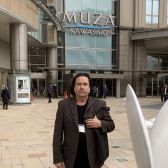 Image: Andrián Pertout at the MUZA Kawasaki Symphony Hall, Japan
 Established in 1973 as a means of promoting art music activities in Asian countries and fostering mutual exchange between these countries, the Asian Composers' League (ACL) is a contemporary music organisation in the Asia-Pacific region currently comprising of fourteen official member countries and regions: Australia, Hong Kong, Indonesia, Israel, Japan, Korea, Malaysia, New Zealand, the Philippines, Singapore, Taiwan, Thailand, Turkey, and Vietnam (Japan and Malaysia represented by a further two organisations with an associate membership status). The inaugural ACL Conference and Festival took place in Hong Kong in 1973, and since then events have been organised annually or biennially.
The Melbourne Composers' League (MCL), an independent non-profit, non-racial, and non-political local organisation that currently represents 121 composers Australia-wide, is the official Australian representative of the ACL with a mission to actively promote the Indigenous and art music of Australia in an Asian Pacific context. Since its inception in 1997, the MCL has presented 747 works in concerts, with 46 curated events juxtaposing the music of Australia with that of another country, including music from Albania, Chile, China, Germany, Hong Kong, Indonesia, Israel, Italy Japan, Korea, Malaysia, New Zealand, Philippines, Romania, Russia, Taiwan, Thailand, Turkey and USA. There were a total of 17 MCL submissions by 10 Australian composers made to the 2025 ACL Festival, and the Japan Federation of Composers (JFC) selected four works: Bruce Crossman's Fragility and Sonorousness for piano (2021), Eve Duncan's Fireflies for flute and guitar (2023), Michael Hannan's Heavenly Bodies for piano (2023), and Andrián Pertout's Entropia for symphony orchestra, no. 441b (2016-2017, Rev. 2024). The composer selected by the MCL to represent Australia at the Asian Composers League Young Composer Competition was Ziv Pinco (a student at the Sydney Conservatorium of Music currently studying under Clemens Leske and Daniel Rojas). The host country is wholly responsible for the score selection, while each member country selects a young composer to represent the country at each festival.
I personally travelled to Japan to attend the festival in Kawasaki on a both official and unofficial capacity; as member of the Executive Committee of the Asian Composers League, and as presented composer, while Johanna Selleck attended as the Australian Delegate of the ACL, which endowed her with the special privilege of presenting a talk about an 'outstanding' Australian work (performed since the previous ACL festival) within the Country Report sessions of the festival. Selleck chose to talk about Brendan Colbert's Movement I, 'Blitz' of Models of Attitude for solo flute (1991-2006, Rev. 2023) - an electrifyingly sophisticated work performed by Selleck herself with a high degree of virtuosic excellence at the Melbourne Composers' League 'Elbow Room mini-festival' on 20 April 2024 at St. Stephen's Anglican Church in Richmond, Melbourne. Other attendees as part of the Australian delegation included Michael Hannan and Ziv Pinco. The festival events base was the MUZA Kawasaki Symphony Hall complex, which houses what is considered one of the world's most beautiful symphony halls. Kawasaki City, situated in Kanagawa Prefecture (18 kilometres from Tokyo) is "one of the main cities of the Greater Tokyo Area and Keihin Industrial Area," and with a population of 1,531,646, the eighth most populated city in Japan.
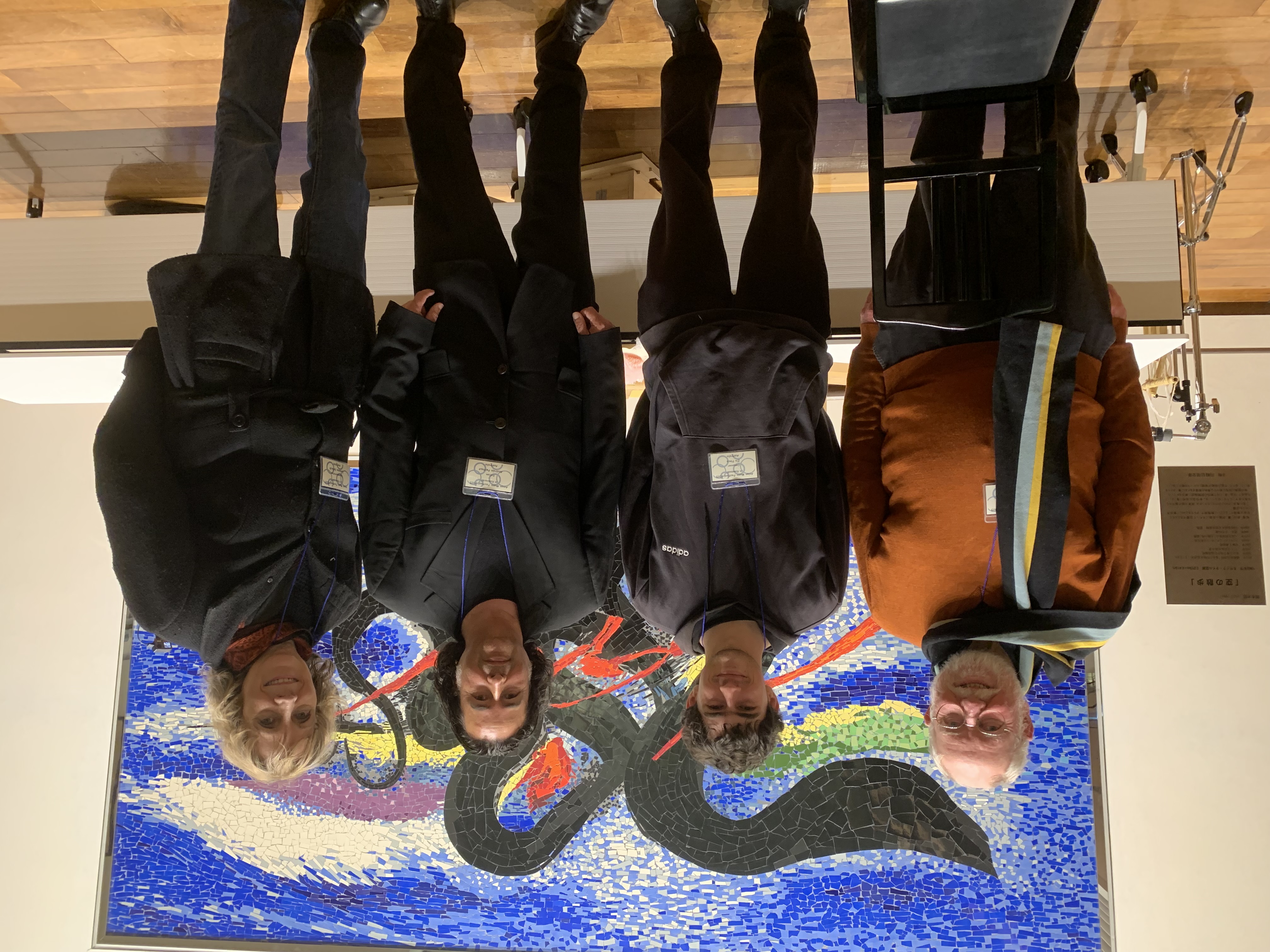
Image: Michael Hannan, Ziv Pinco Andrián Pertout, and Johanna Selleck, (Australia) - 37th Asian Composers League Festival & Conference, Japan
The opening concert, 'Japanese Traditional Instruments', presented on Monday 3 February at the MUZA Kawasaki Symphony Hall Foyer featured the Japanese traditional ensemble Mahoroba conducted by Yutaka Takahashi, comprising of Reison Kuroda (shakuhachi), Hidejiro Honjoh (shamisen), Hideeiji Honjoh (kokyu), Nobutaka Yoshizawa (koto), and Kisaburo Katada (Narimono percussion), and performing the music of Akira Ito (Japan), Takuo Kochi (Japan), Kohei Michino (Japan), Li-Wei Chao (Taiwan), Takashi Matsuoka (Japan), Tomoyuki Hisatome (Japan), and Yutaka Takahashi (Japan). This event was absolutely stunning, with highlights including Li-Wei Chao's (Taiwan) The Wind Rises Trio for shamisen, shakuhachi and koto (featuring bowed koto) - a stylistically fiery work with attitude and an expansive and contrasting expressiveness; and Tomoyuki Hisatome's (Japan) Organic Motions IV for shakuhachi - it's utilization of nuanced vibrato; long notes ornamented with acciaccaturas, appoggiaturas, glissandos, slides, trills, microtonal inflections; tonal centre modulations, as well as a melodic invention full of tension and colour, inspirational. The closing work, Yutaka Takahashi's (Japan) Kamnabi for Hogaku ensemble, an extravagant and ritualistic work of great entertainment value, densely populated with solos and riffs galore.
'Chamber Music Concert Ⅰ: Piano+' on Day 2 was presented at the MUZA Kawasaki Assembly Room, and featured Masanobu Shinoda, Toshio Nakagawa, Musashi Ishikawa (piano), Saori Nakazawa (violin), and Koya Suzuki (violoncello) performing the music of Adeline Wong (Malaysia), Zhi Yong Tan (Malaysia), Daïsuké Kinoshita (Japan), Chih-Shiuan Liu (Taiwan), Stephen Yip (Hong Kong), Michael Hannan (Australia), Jessica Cho (Malaysia), Bruce Crossman (Australia), and Yoshibumi Fujiwara (Japan). Adeline Wong's (Malaysia) Crossings for piano was Stockhausen-Klavierstücke-like excellence. This was music conceived as a grand exploration of the complete tessitura of the featured instrument, but with ample breathing space, and expertly interjected with recurring bursts of energy consolidating fast sporadic gestures. Bruce Crossman (Australia) is a composer with a voice, and so his Fragility and Sonorousness for piano was a manifestation of artistry at the highest levels of compositional craft and creativity; a musical language distinctly stamped with the Crossman 'intercultural' label, and what I would refer to as exhibiting quasi-improvisational 'jazz-but-not-jazz' sensibilities that today succinctly define Crossman as a true 'original' of our times. Michael Hannan's (Australia), Heavenly Bodies for piano a standout - a beautifully rich harmonic work developed superbly, and what could be described as a twenty-first century Debussy reborn with abundant modernity.
The second offering of the day entitled the 'ACL Commission Concert' is an entirely new initiative by the Asian Composers League that was recently instigated by the Executive Committee with the aim of introducing a fully-funded concert independent of the festival's curatorial protocols. The four works in this program were hence commissioned by the ACL Executive Committee with the support of the Ernst von Siemens Music Foundation. The pilot program was also presented in the Assembly Room featuring Saori Nakazawa (violin), Koya Suzuki (violoncello), and Musashi Ishikawa (piano) and performing the music of Kee Young Chong (Malaysia), Hitomi Kaneko (Japan), Michael Norris (New Zealand), and Tsung Hsien Yang (Taiwan). Michael Norris (New Zealand) proved to be once again an artistic force to be reckoned with, as his The Spaces in Between for piano trio was pure tension-building magic. A subtle microtonal entry with long sustained notes beating with the piano (alluding to the just intonation explorations of American composer/pianist Michael Harrison), drone fashioned tonal centres interjected with asymmetric piano flurries, and quasi-minimalistic musical interludes went on to generate an extremely stimulating artistic tapestry full of contrast and colour.
Day 3 began with the presentation of two insightful lectures at the MUZA Kawasaki Assembly Room on 'Japanese Traditional Instruments' by composer and Gagaku performer Naoyuki Manabe, and koto performer Michiko Takita. 'Chamber Music Concert Ⅱ: Brass' was later presented at the Symphony Hall Foyer, and featured Kiyonori Sogabe, Tomonori Sato (trumpet), Atsushi Doyama (horn), Kosei Murata (trombone), and Shinya Hashimoto (tuba) performing the music of Mikako Mizuno (Japan), Jun Yamamoto (Japan), Yan Ee Toh (Singapore), Chee Kong Ho (Singapore), and Kenshiro Matsuo (Japan). Kenshiro Matsuo's (Japan) Duo for Trombone and Brass Quartet left a group of composers with a sense of wonderment. The work was undeniably a brass masterwork, but what was the brass technique that intrigued us all? It was the F-trigger on the trombone, producing a sonic illusion of a higher register echoing melodic fragments, or subsets of the melodic line. To our delight (following post-concert discussions with trombonist Kosei Murata), the score revealed that this sensational effect had been notated as designated notes on separate second staff.
The second offering of the day entitled 'Chamber Music Concert III: Strings' was presented at the MUZA Kawasaki Assembly Room, and featured Maiko Matsuoka, Yoshu Kamei (violin), Kei Sakoda (viola), and Seiko Takemoto (violoncello) performing the music of Ja Young Baek (Korea), Yu Hng Ng (Singapore), Hisako Imamura (Japan), Midori Kubota (Japan), and Aris Daryono (Indonesia). There was no doubt that the highlight of this concert was Aris Daryono's (Indonesia) Cekaking Carita for string trio (draped in modernity with fresh appeal), which again showcased the microtonal creative space, with its long detuning-over-time 2-string unisons, quarter-tone designated wanderings, and microtonal vertical simultaneities.
Day 4, within a concert entitled 'ACL Young Composers Awards Competition Concert' at the MUZA Kawasaki Assembly Room presented the Asian Composers League Young Composers Competition featuring an all-stars saxophone quartet with woodwind luminaries Masanori Oishi, Ryoko Egawa, Yuko Tomioka, and Takuya Tanaka. Tokyo University of the Arts and Conservatoire National Supérieur de Musique de Paris graduate Masanori Oishi is an incredible player, and in 2022 had the great honor to work with Oishi (as well as guitarist Gaku Yamada) as part of the performance of my work Dance of the Neutron Stars for alto saxophone and guitar, no. 470 (2021), which was commissioned by the Japan Federation of Composers in celebration of the 60th Anniversary of the Japan Federation of Composers and 50th Anniversary of the Asian Composers' League, and premiered as part of the Asian Music Festival 2022 in this same very room. The ACL Young Composers Competition concert featured music from Australia, Hong Kong, Israel, Japan, South Korea, Malaysia, New Zealand, the Philippines, Singapore, and Taiwan. It should be noted that the Australian Delegate of the ACL is personally responsible for not only selecting but also mentoring and nurturing a young composer under the age 30 from Australia as part of their participation in the ACL Young Composer Competition that takes place within the framework of an ACL festival and conference in one of fourteen countries in the Asia Pacific. The competition has a total of US$1,000 in cash prizes (given to up to three winners), with the winner of the first prize invited to write a new work to be premiered during the next ACL festival (hotel accommodation provided for the duration of the festival). The composer selected by the MCL to represent Australia was Ziv Pinco from the Sydney Conservatorium of Music with the work Late to Work! for saxophone trio (2024), which proved to be an engaging and admirable work in the program.
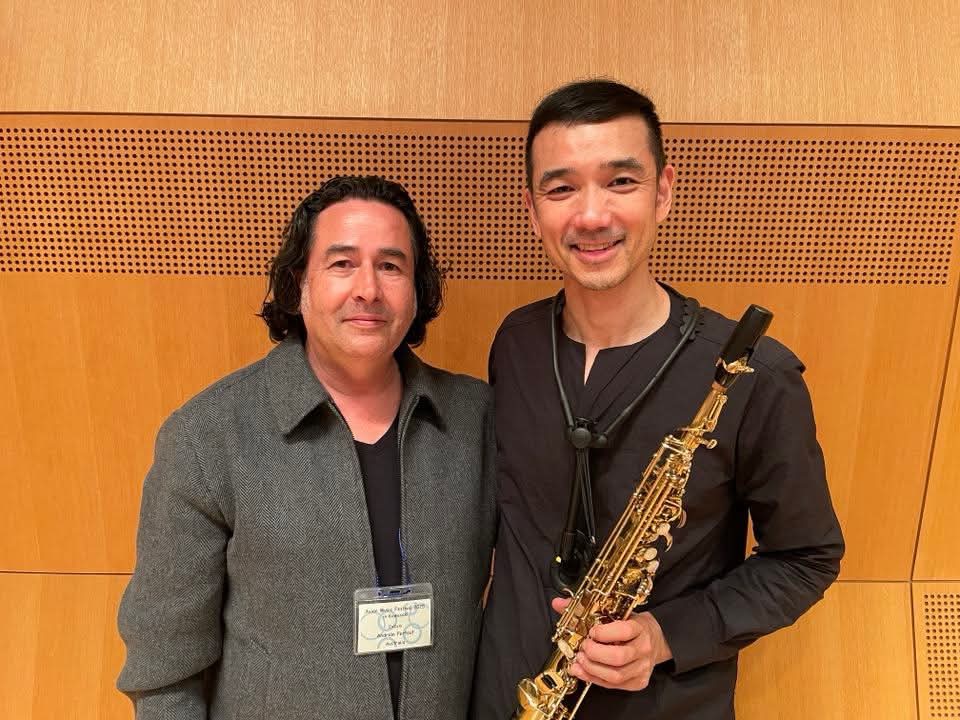
Image: Andrián Pertout (Australia) and Masanori Oishi (Japan) - Asian Composers League Young Composers Competition, Japan
The second offering of the day entitled 'Chamber Music Concert IV: Winds and Guitar' was also presented at the Assembly Room, and featured Kazuhiro Kajihara (flute), Masato Oki (oboe), Ryuta Iwase (clarinet), Rie Tsukahara (bassoon), Jo Kishigami (horn), and Tsunehito Tsuchihashi (guitar) performing the music of Atsuko Kokubo (Japan), Naoko Kurauchi (Japan), Kyoichiro Mii (Japan), Wei Chern Ooi (Malaysia), Ronnie Reshef (Israel), Eve Duncan (Australia), Tchangsun Ryu (Korea), and Seung Jae Chung (Korea). Naoko Kurauchi's (Japan) Neo Jasmine: Resistance for flute was an excellent offering to the contemporary solo flute repertoire, with its extraordinary acrobatics and an animated bag of tricks full of surprises.
'Chamber Music Concert V: Electro-Acoustic' on Day 5 was presented at the MUZA Kawasaki Assembly Room, and featured the music of Lily Chen (Taiwan), Fang-Wei Luo (Taiwan), Otto Sidharta (Indonesia), Maria Christine Muyco (Philippines), and Hyunsuk Jun (Korea) with sound direction by Sumihisa Arima. Otto Sidharta's (Indonesia) Kerikil II certainly evoked Kajang village's organic life-cycle (a village in south-east Sulawesi that rejects the influence of any kind of modern technology, even electricity); while Maria Christine Muyco's (Philippines) Uma' (Farm) Dwellers and Whisperers with its "imagined conversations within bamboo groves, avian spirits, and supplications during a moonlit night" was music that juxtaposed nature and technology (the 'man and machine' conceptual framework) in a very effective way. The closing work, Hyunsuk Jun's (Korea) Anatomy I, was a stunning example of "tape music that uses materials recorded with a single instrument," and succeeded artistically on many levels. The composer explains: "In the work, music is played from the organic perspective, drawing sounds consisting of connecting, dissembling, and synthesis for each organ of the piano, including various sounds and noises between fingers and keys, keys and hammers, and collateral sound through pedalling."
The second offering of the day entitled 'Chamber Music Concert Ⅵ: Percussion' was also presented at the Assembly Room and featured Kanda Yoshiko, Kataoka Ayano, and Tozaki Karin (percussion) performing the music of Robert Casteels (Singapore), Young-Eun Paik (Korea), Kaori Nabeshima (Japan), Naoko Kachi (Japan), and Alona Epshtein (Israel). Robert Casteels's (Singapore) Arch Opus 140 for percussion trio, Kaori Nabeshima's (Japan) Sparkling Time X for percussion trio, and Naoko Kachi (Japan) Terra for marimba duo were certainly great works of art worthy of praise, but unquestionably overshadowed by the sheer quirkiness of Alona Epshtein's (Israel) Winter Spells for percussion trio. This was music for theatre: entertaining, funny, witty; although without question the credit must be accorded to the outstanding performers who not only studied the piece with great dedication and spirit, but more importantly established the musical language (interpretation, including adapted instrumentation) that made this performance a success in the first place.
The closing of the concert delivered the results of the ACL Young Composers Competition, and other awards presented as part of the Festival. The ACL Young Composers Competition culminated with three prizes awarded: first, second and third prizes going to Chih-Yun Wang (Taiwan), Leon Nagami (Japan), and Nathaniel Otley (New Zealand). The 2025 Tsang-Houei Hsu Memorial Prize was divided between two young Japanese composers: Kenshiro Matsuo for his work Duo for trombone and brass quartet and Akira Ito for his work Live in the Present for shakuhachi and shamisen. This award, initiated in 1988, nominates the best musical work by a composer from the host country under the age 35 at each ACL festival. The judges for the 2025 ACL Festival awards and prizes included the following: 26th ACL Young Composers Competition: Kee Yong Chong (Malaysia), Johanna Selleck (Australia), Chung Shih Hoh (Singapore), Seung Jae Chung (Korea), Toshio Nakawa (Japan); and 2025 ACL 2025 Tsang-Houei Hsu Memorial Prize: Hsien-Sheng Lien (Taiwan), Andrián Pertout (Australia), Ramón Pagayon Santos (Philippines).
Japan's work culture is widely acknowledged for its efficiency, dedication, and emphasis on harmony and respect, as well as meticulous attention to detail and precision. When you combine raw talent with the abovementioned you get pure magic. And this distinct sentiment is at the heart of how we, the 'invited' composers of the 37th Asian Composers League (ACL) festival felt at the onset of our encounter with this mighty artistic entity that is the Tokyo Symphony Orchestra - on this particular occasion, under the stellar direction of esteemed Japanese conductor Kazufumi Yamashita. From the very first rehearsal there was a sense of clarity in unquantifiable abundance, which is certainly unheard of in the unique and at times esoteric domain of contemporary classical orchestral music. 'New Music' may seem challenging for audiences, but for the players the challenge is often at the edge of the unsurmountable as their faithful interpretation relies solely on extensive dedicated study and musical prowess, in view of the fact that in most cases no precedence exists for that work's performance practice.
The closing concert of the ACL festival on Friday 7 February 2025 at the beautiful MUZA Kawasaki Symphony Hall opened with the world premiere of Chung Shih Hoh's (Singapore) Distancing Echo for orchestra (2021), which in the composer's own words attempts to express the "social conditions of separation and distancing during the COVID-19 pandemic." It proved to be a highly rich harmonic work, rooted in a modernist musical language, with a beautiful expansive energy that connects thematically with the composer's intention of continuously forming melodies "fragmented in time, register and colour." The opening of Jonathan Domingo's (Philippines) Particles in Motion for orchestra (also a world premiere) was a stunning example of great practice twenty-first century imaginative orchestral writing. Bringing to life a painting by Jordan Velikov entitled 'Bei Ihr' - that according to Domingo conjures up the "scientific, cell-like, celestial" - was executed with a great sense of finesse and elegance. The work that followed, June-Hee Lim's (Korea) Concerto for daegeum and orchestra, Honbul (Spiritual Fire) VII - Encounter succeeded on many levels. This is music with a depth in spirit and compositional fluidity that with certainty defines artistic excellence. Lim achieves a flawless continuity that allows the music to breathe yet never distances itself from its primary objective - to highlight the incredibly passionate and highly emotive playing of Korean daegeum virtuoso Aram Lee. This is extremely moving music that travels sequentially between orchestral melodic interpolations and elegant cadenzas. My own work, Entropia for symphony orchestra, is a dedication to Peter Sculthorpe (unquestionably Australia's most celebrated contemporary composer), who was the teacher of my teacher (Brenton Broadstock) and hence representative of a symbolic continuation of this great Australian composer's monumental musical legacy. The work serves as an exploration of the second law of thermodynamics, and attempts to present a sonic interpretation of the "state of disorder of a system at the atomic, ionic, or molecular level" utilizing an 'invented' musical language to generate the 'artistic' representation of the concept. What struck me personally about the Japanese premiere performance of this new arrangement of the work (especially created for the TSO) is that the subtle nuances and timbral contrast of the orchestration was brought to life in extraordinary fashion, with not only every individual instrumental line clearly audible and articulated with immense passion, integrity and leadership but also the underlining orchestral substructural groupings. The lyrical and expressive violin solo performed by TSO concertmaster Gleb Nikitin with impeccable musicality, while the shared mallet solo (wildly traversing through antipodal metric modulations in one-measure blocks) executed by the percussion section with superb acrobatic balance. The Japanese premiere of Yoshihiro Kanno's (Japan) Piano Concerto No. 1: Oceanic Ridge closed the concert. The featured pianist, Noriko Ogawa (Japan) was astounding, and the level of energy of this work did not ever subside at any point in the structural timeline. The music was intensely electric and what could be truly described as a musical rollercoaster ride headed straight towards the edge of the abyss. The ostinatos in the left hand pounded the sonic airwaves, while the never waning thrill-seeking melodic avalanches raced onwards unabated. The MUZA Kawasaki Symphony Hall is considered one of the world's most beautiful symphony halls, but apart from its structural beauty there is its sonic beauty, which is simply amazing - a clarity of sound that I would consider on par with the greatest halls around the world. Tokyo Symphony Orchestra's reputation as Japan's 'premiere' orchestra could not be challenged in this concert, and conductor Kazufumi Yamashita's command over the music as well as his obvious artistic presence and sincerity in the execution of this collection of twenty-first century gems was magic to the ears.
The next ACL festival will take place in Taiwan in 2026.
Further links
© Australian Music Centre (2025) — Permission must be obtained from the AMC if you wish to reproduce this article either online or in print.
Andrián Pertout is a freelance composer with a PhD in Composition from the Melbourne Conservatorium of Music (University of Melbourne). His music has been performed in over 50 countries around the world. He is currently President of the Melbourne Composers’ League (2024-); Member of the Executive Committee of the Asian Composers’ League (2022-); Australian delegate of the Asian Composers’ League (2007-2022); International coordinator, PUENTE Festival Interoceánico, Valparaíso, Chile (2019-); Member of the Editorial Board, Eurasian Music Science Journal, The State Conservatory of Uzbekistan, Tashkent, Uzbekistan (2022-); and was Visiting Professor of Composition at Aichi Prefectural University of the Arts, Nagakute, Aichi Prefecture, Japan (2024 and 2019).



Comments
Be the first to share add your thoughts and opinions in response to this article.
You must login to post a comment.