30 July 2024
Stradella Suite: A new future for the stradella piano accordion in Australia
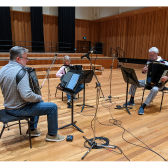 Image: Fisarmonica Amici (Bradley Voltz, Nerida Farmer and John Cave) recording Stradella Suite at the ABC Centre in Southbank, Brisbane.
 Last month, ABC Classic released its recording of Stradella Suite, a thirty-minute, six-movement suite for stradella piano accordion trio, which it commissioned as part of the Australian Broadcasting Corporation's 2022 Composer Commissioning Fund. To the best of our knowledge, this is a notable composition, in that it is Australia's first serious art music composition for such an ensemble. In this short article, we explore likely causes for why such an absence of contemporary art music exists for the stradella accordion, as well as strategies for composers interested in adding to the instrument's repertory. Conclusively, some cursory remarks are made specifically about Stradella Suite.
The stradella piano accordion is an instrument that is tarnished by an enduring and gravely erroneous stereotype: that it is merely a light instrument, capable only of comedic gimmicks and vaudeville acts. Certainly, the stradella accordion was once the darling of the vaudeville stage, popularised during the twentieth century by virtuosic pioneers like Guido Diero, Pietro Frosina and Charles Magnante. In America, but also in Australia, there was such interest in the instrument that from accordion schools grew established bands and orchestras. Bands, together with solo, duet, and other small group performances featured in concerts devoted solely to the accordion. For instance, the Italian émigré and accordion virtuoso Osvaldo Mazzei (1913-2017), known simply as Ossie, had by 1962 developed a successful teaching studio in Brisbane's Fortitude Valley from which an orchestra of eighty accordionists had formed.
We have been pleased by the increasing volume of accordion music that appears in, for example, Brett Dean's catalogue of works. Dean includes the accordion as an orchestral force in compositions like The Last Days of Socrates (2012), as well as his opera Hamlet (2016). Indeed, material in Hamlet later led to a twenty-minute accordion concerto, The Players, in 2018/19. But this is all music for the free-bass, button accordion. Simply put, the free-bass accordion affords a more liberal left-hand bass buttonboard that better facilitates chromatic and atonal writing. Conversely, the stradella instrument adopts a chordal bass system; its buttons are arranged in sequences of major, minor, dominant and diminished chords. This system is often misinterpreted by contemporary art music composers as harmonically restrictive, unable to support modern and complex writing styles. More, the stradella piano accordion features a keyboard, as opposed to a right-hand buttonboard. Whilst the piano accordion is still capable of intense virtuosity, the geography of the button accordion facilitates even greater technical freedoms.
The present community view, therefore, is that the stradella piano accordion is a trivial and limited instrument. We refute this view. Our experience has been that the stradella instrument affords great artistic reward. Furnished with its fixed yet unique bass system and its registers of varying timbres, as well as depending upon the flow of air to produce sound, it is, in our mind, best imagined as a handheld pipe organ. And, like the pipe organ, or the harp, the stradella instrument, despite its palpable characteristics, still offers the composer a myriad of musical possibilities. What we do concede, however, is that these musical possibilities are achieved only through a surety of craft; that is, just as when writing for the organ or the harp, the risk of an uninspired, rigid result is increased dramatically if the composer does not properly grasp the instrument's idiosyncrasies. To that end, composers writing for the stradella piano accordion are best advised to maintain in frequent communication with those who are its specialists; we are very happy to offer our services.
Because of the stradella accordion's vertical piano keyboard, which is, musically, a more significant feature than its bass buttonboard, one compositional exercise is simply to write for piano right-hand - taking care not to forget that accordions are without sustain pedals. In this exercise, it is wise to consider that the accordionist's right hand also switches between the accordion's reeds; music that allows for this action, and which is also timbrally conscious, is best placed to succeed. Although the accordionist is alike an organist tasked with independently adjusting their instrument's stops, any reed on the accordion is capable of dynamic expression. Importantly, fluctuations in volume are uniform across the instrument; the right hand cannot play at a dynamic level that is independent to the left hand, and vice versa.
Having developed confidence writing for the right hand, material for the left-hand buttonboard can next be carefully approached. While many buttons can be combined to create interesting and contemporary chordal structures, some combinations of buttons may, because of tempo or, more critically, the size of the performer's left hand, be awkward or impossible. Then, there is a most archaic reality with which composers must vie. Softly held notes of significant durations represent challenging writing, insofar as the accordionist must slowly yet smoothly manipulate heavy bellows. The success of such notes depends literally upon the players skill in controlling the bellows. Therefore, again, we recommend composers consult with experienced accordionists to ensure their writing for the stradella instrument's left hand is intelligent.
If writing for multiple stradella accordions, the composer's possibilities expand exponentially. Chromatic and atonal languages are more easily realised, as is counterpoint and polyphony. What should be remembered is that most accordions - and even those built by the same manufacturer to identical specifications - possess their own unique timbre. In this respect, their tone is more akin to the string instrument than to the pianoforte. In other words, when two or three accordions combine, distinguishable timbral effects can be achieved. (This quality, though, gradually becomes less noticeable as the size of the accordion ensemble increases.) To best capture the pitch and timbrel potentials of the stradella instrument ensemble, it seems to us better to avoid reductive compositional methods and, instead, write in full score from the outset, deliberately considering each instrument, particularly which registrations best extend the timbral palette.
Stradella Suite attempts to successfully comprehend the stradella piano accordion's nature and details. The suite comprises six movements. An introduction and epilogue bookend three dances - "Grande Valse", a waltz; "Vacanza Cubana", a tango; and "Toorak Trot", a polka - as well as a more introspective, penultimate movement, "Poema". "Introduzione", "Poema" and "Epilogo" are more concert-like in conception, whereas the three dances are, in fact, comic and light, each suited to stand-alone radio broadcast (as was, in some ways, a deliberate specification of the commission). For whilst each movement expands upon preconceived notions of what is idiomatic for stradella accordion, Stradella Suite does not ultimately reject these notions. "Grande Valse" is principally a waltz, but it is a waltz constructed from a fresh approach to stradella accordion writing; the same could be said of "Vacanza Cubana" as a tango and "Toorak Trot" as a polka. In this light, Stradella Suite succeeds as a work that is accessible for traditional and curious audiences alike. Indeed, we contend that to completely depart from an accordionistic style - and that is not at all to say that much distance cannot first be traversed before such a departure even begins to resemble completion - is ill-advised. The accordion most succeeds when music's foundational pitch parameters of melody, harmony and counterpoint are embraced and expanded upon.
For us, Stradella Suite seeks to break down stereotypes and celebrate what has, for no good reason, been largely forgotten. Our continuing endeavour is to reignite interest in the stradella piano accordion. This is an instrument that deserves its renaissance. We argue that, today, the stradella accordion maintains the serious, concert-hall appeal which propelled the heights of its popularity during the twentieth century. We hope that you enjoy Stradella Suite, and that this article inspires and assists contemporary art music composers. Indeed, let those composers' eventual forays into the stradella accordion, this remarkable instrument, capture the imaginations of Australia's conductors, artistic planners and concert-going public.
Stradella Suite is composed by Alexander Voltz and recorded by the Australian stradella accordion trio, Fisarmonica Amici - Bradley Voltz, Nerida Farmer and John Cave - for ABC Classic. Purchase or stream online.
© Australian Music Centre (2024) — Permission must be obtained from the AMC if you wish to reproduce this article either online or in print.
Alexander Voltz is a composer represented by the Australian Music Centre and the Music Editor of Quadrant. Bradley Voltz is an accordionist and educator whose Doctorate of Philosophy, ‘The Digital Piano Accordion: A Modern Instrument for Traditional and Contemporary Performance Contexts’, has achieved international recognition.
Comments
Be the first to share add your thoughts and opinions in response to this article.
You must login to post a comment.